
January 21, 2026 amended February 2026
To: Harmeet Dhillon, US Department of Justice - Civil Rights Division
950 Pennsylvania Avenue NW Washington DC 20530
RE: Complaint to end the Senate Blue Slip Policy
Sent via email to:
Dear Ms Dhillon,
The Washington Parents Network is a group of several thousand US citizens in Washington state. Because the current political leaders in our state have almost no respect for our civil rights, federal laws or the US Constitution, our right as parents to control the upbringing of our children is being violated on a daily basis. Thus, during the past year, we have been forced to submit 7 complaints to the Department of Education and/or the Department of Justice. Our previous complaints included hundreds of pages of specific examples of violations of our civil rights. ( Section 1 of this complaint provides a summary of these 7 past complaints.)
This is our eighth civil rights complaint. In a nutshell, we need at least one valid, Senate approved US Attorney for Washington state who is vested with a clear power to investigate our 7 prior complaints and, after finding them to be accurate, to file charges in federal court. Unfortunately, due to threats by Washington Senator Patty Murray, to use an unconstitutional “Blue Slip” policy to block Senate consideration of our “acting” US attorneys, we have no hope of getting a valid US Attorney in our state with the clear power to investigate and take action on our past complaints.
The First Amendment states in part: “Congress shall make no law… abridging... the right of the people peaceably to assemble, and to petition the Government for a redress of grievances. “
Congress, as referenced in the First Amendment, includes the US Senate. We contend that the current Senate Blue Slip policy - allowing a single Senator to block the appointment of US attorneys in Washington state– has abridged and continues to severely abridge and obstruct our right to petition the Government for a redress of grievances.
This is because the US attorney is the person most specifically responsible for investigating our complaints and enforcing our civil rights. While the Senate is entitled to make their own rules, the Senate is not entitled to make rules that violate fundamental rights of the people as established in the US Constitution. The Senate Blue Slip policy is unconstitutional because, as currently practiced, it severely abridges the First Amendment right of the people to petition the Government for redress of grievances.
In addition, the Senate Blue Slip policy, as currently practiced, violates the Separation of Powers provisions of Articles I, II and III of the US Constitution by allowing a single Senator to block the Executive Branch appointment of US attorneys – one of the core functions of the Executive Branch protected by the Article II Vesting Clauses – and thus renders our national elections for President to be meaningless.
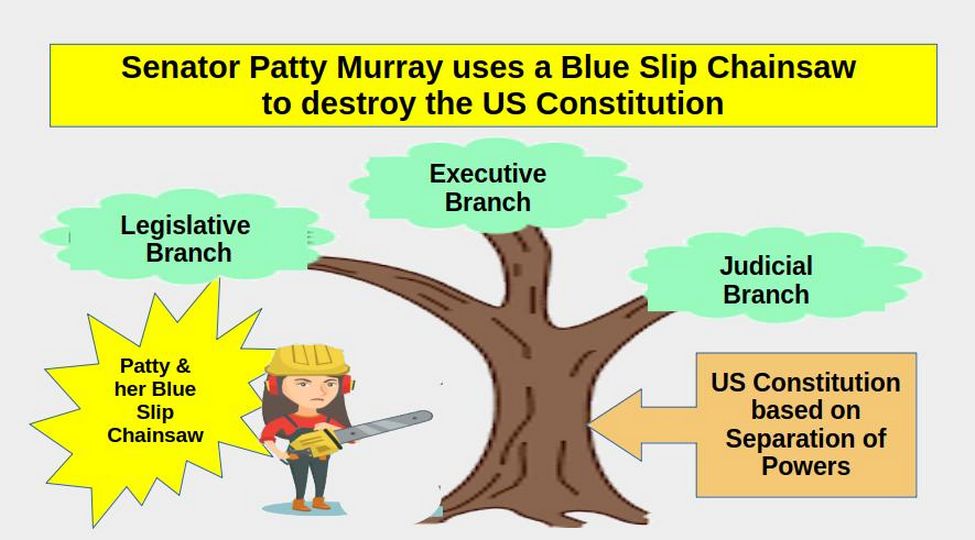
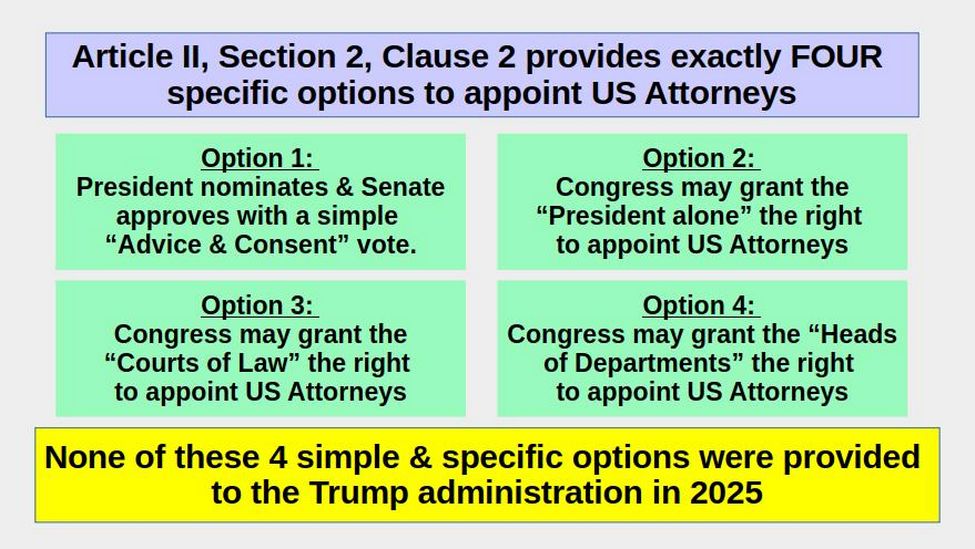
Equally important, the Senate Blue Slip Policy violates Article II, Section 2, Clause 2 commonly known as the Appointment Clause of the US Constitution. Article II, Section 2, Clause 2 provides that the president "shall nominate, and by and with the Advice and Consent of the Senate, shall appoint Ambassadors, other public Ministers and Consuls, Judges of the Supreme Court, and all other Officers of the United States, whose Appointments are not herein otherwise provided for, and which shall be established by law; but the Congress may by Law vest the Appointment of such inferior Officers, as they think proper, in the President alone, in the Courts of Law, or in the Heads of Departments.
US Attorneys are “Inferior Officers” protected by Article II, Clause 2 Section 2. The meaning of the term “Consent” in Article II, Clause 2 requires a simple majority vote of the Senate. The Senate does not have the power to use a Blue Slip policy to allow a single Senator to block the Advice and Consent process.
In an effort to get around the unconstitutional Senate Blue Slip policy, in 2025, the Department of Justice attempted to use various federal laws, including 28 US Code Section 541 and Section 546 and the National Vacancy Reform Act (NVRA) to create either “Acting” or “Special” US Attorneys. Thus far, seven federal courts have issued rulings blocking these efforts by the Department of Justice as being violations of Section 541, Section 546 and the NVRA. (We provide a summary of these 7 federal court rulings in Section 4 of this complaint).
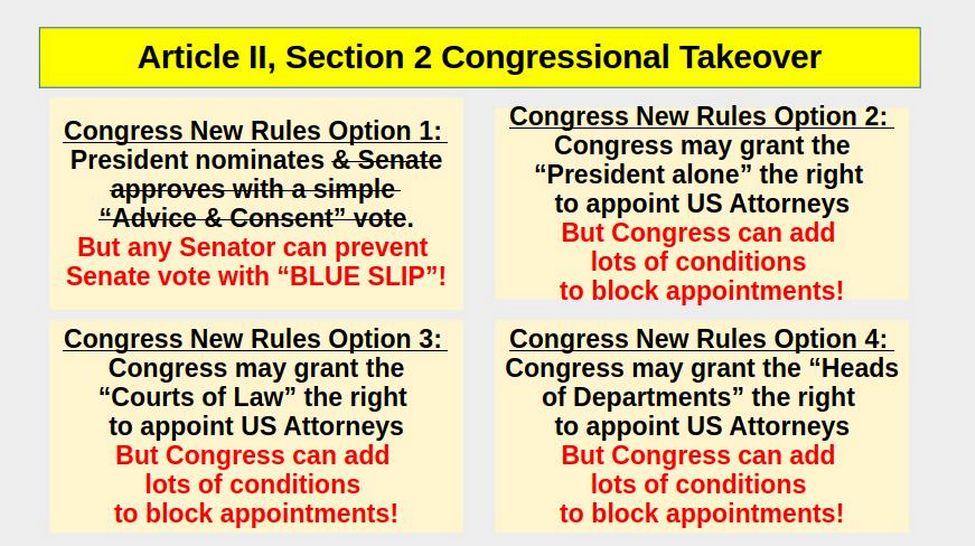
We contend that all three of these federal laws - 28 US Code Section 541 and Section 546 and the National Vacancy Reform Act (NVRA - fail to comply with the simple framework of Article II, Section 2, Clause 2 and are therefore unconstitutional. The problem with all three laws is that they place a complex series of obstacles in the way of appointing a permanent and valid US Attorney for each district. These obstacles violate the “Inferior Office” options that are specifically and clearly spelled out in Article II, Section 2, Clause 2:
Together, Section 541, Section 546 and the NVRA constitute an unconstitutional Congressional Takeover of the Appointment powers reserved for the Executive Branch:
While our primary goal is protecting the inalienable right of parents to raise their children, we recognize that this right can not be protected unless our First Amendment civil right to “petition the Government for redress of Grievances” is also protected. While this right extends to all three branches of government, it is the primary core duty of the Executive Branch of the Government to enforce the US Constitution and federal laws. Enforcement of federal laws by the Executive Branch rests primarily with the US Department of Justice. The Civil Rights Division of the Department of Justice was created by the Civil Rights Act of 1957 specifically to uphold the civil and constitutional rights of all persons in the United States.
We are therefore submitting this Complaint to the Civil Rights Division of the US Department of Justice and requesting that the Civil Rights Division take specific and immediate steps to end the US Senate Blue Slip Policy so that we, the citizens of Washington state can get a US Attorney to enforce the “Petition for Redress of Grievances” Clause of the US Constitution.
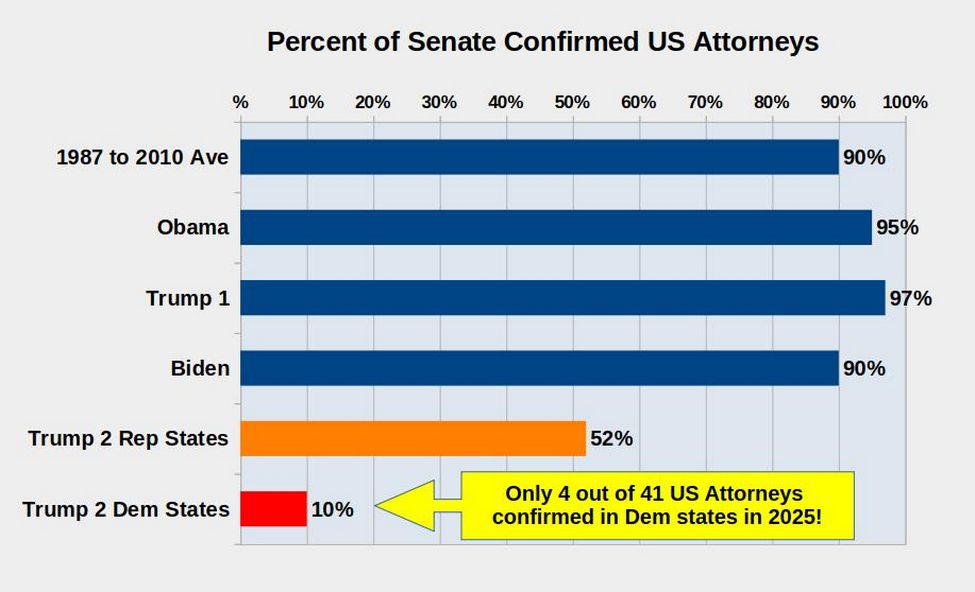
Due to the Senate Blue Slip policy, while 27 out of 52 US Attorneys were Senate Confirmed in 2025 in states with Republican Senators, only 4 out of 41 US Attorneys were confirmed in states with Democrat Senators.
Below is an image of US States with at least one US Attorney confirmed by the US Senate in 2025:
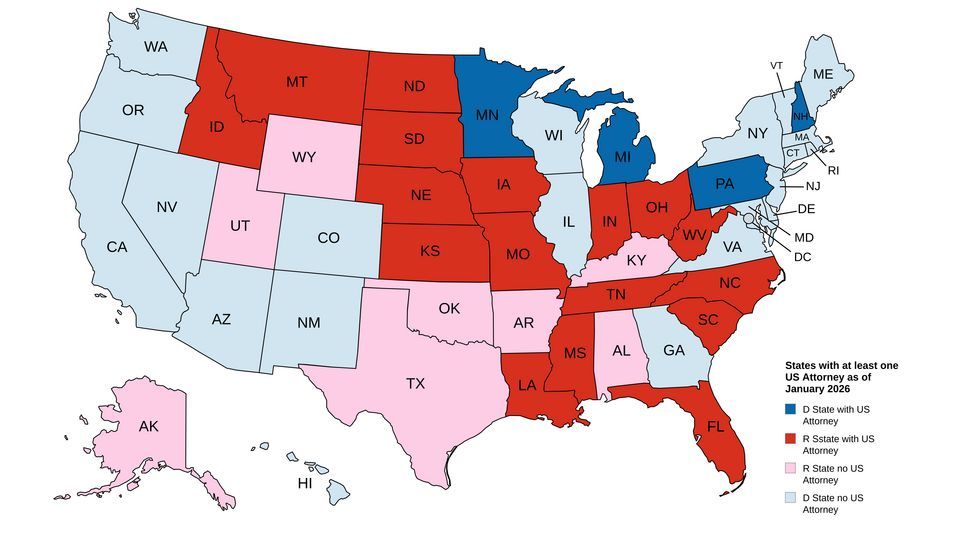
Note that there are 17 states with Republican Senators that have at least one Senate confirmed US Attorney and only 7 Republican States without a Senate confirmed US Attorney By Contrast, there only 4 states with Democrat Senators with at least one US Attorney and 20 Democrat States without a Senate confirmed US Attorney!
We have divided this complaint into eight sections:
Section 1 provides a summary of our previous 7 complaints each of which requires investigation and resolution by a US attorney here in Washington state – but none of which are being addressed due to a single Senator blocking the appointment of a US attorney here in our state.
Section 2 provides an analysis of each word of Article II Section 2 of the US Constitution - confirming that the drafters of the US Constitution wanted a strong federal government and would have opposed a Senate One Person Veto of Presidential Nominees
Section 3 explains why the NVRA is Unconstitutional.
Section 4 explains why 28 US Code Sections 541 and 546 are Unconstitutional.
Section 5 provides a summary of current litigation on the obstruction of US Attorney appointments including a summary of 7 cases in the Ninth Circuit, Third and Fourth Circuits.
Section 6 provides a summary of the actions of the US Senate in 2025 blocking the appointment of a US attorney here in Washington state. This includes a summary of the status of all 93 US attorneys in the US.
Section 7 provides a summary of the historical importance of the Redress of Grievances clause – which dates back to the Magna Carte - and the Fifth Amendment Right to Due Process Clause.
Section 8 outlines our proposed remedy to restore a functional federal government. We ask that the Department of Justice demand that the Senate immediately end this Blue Slip practice. Should the Senate refuse to end this illegal policy, then we ask the Department of Justice to file a complaint with the Supreme Court for a ruling that prevents the Senate from using any policy that gives a single senator the right to block a vote on Presidential nominations. We further ask the DOJ to seek a Supreme Court ruling that 28 US Code Sections 541 and 546, and the NVRA violate Article II, Section 2, Clause 2 of the US Constitution.
Thank you for helping to restore and protect the right of the people to petition the government for redress of our grievances.
Sincerely, David Spring M. Ed. Director, Washington Parents Network
One Page Summary of our Complaint
Article II, Section 2 of the US Constitution states in part:
“He shall... nominate, and by and with the Advice and Consent of the Senate, shall appoint... all... Officers of the United States...which shall be established by Law: but the Congress may by Law vest the Appointment of such inferior Officers... in the President alone, in the Courts of Law, or in the Heads of Departments.”
Our complaint explains why the word “Shall” as used in Article II, Section 2, creates a binding legal obligation for the President to nominate and the Senate to provide “advice and consent” on the appointment of every US Attorney. Any policy, statute or action that fails to comply with Article II, Section 2 is unconstitutional.
The Blue Slip policy in which a single Senator can prevent a Presidential Nominee from receiving a confirmation vote by the full US Senate is therefore unconstitutional.
Three federal statutes, 28 US Code Section 541 and Section 546 and the National Vacancy Reform Act (NVRA - also fail to comply with the specific appointment options provided for in Article II, Section 2 and are therefore unconstitutional.
In addition, the creation by the Executive Branch of any additional officers which have not been been established by Law through an Act of Congress - and which have not been appointed through the specific provisions of Article II, Section 2 is also unconstitutional. Thus, the creation of any “Special US Attorney” is also in violation of Article II, Section 2 of the US Constitution.
Finally, as the US Attorney in each federal district is the person most responsible for protecting the civil rights of the citizens in that federal district – and is therefore the person who the People have a right to Petition for redress of grievances, the failure to provide a “valid” US Attorney in any federal district is a violation of First Amendment of the US Constitution which states in part that:
“Congress shall make no law… abridging... the right of the people... to petition the Government for a redress of grievances.”
Section 1 Summary of our 7 prior complaints to restore Parental Rights
During the past several years, the current political leaders in Washington state have been waging a war against families and the right of parents to raise their children. We as parents have had no recourse to restore our rights because our current Governor (and former Attorney General), Bob Ferguson, was and still is the the chief opponent of parents rights. – along with the current State Superintendent, Chris Reykdal. To make matters even worse, the current Washington state Attorney General (and former US Attorney for Western Washington), Nick Brown is also opposed to parental rights.
Thankfully, in 2024, Donald Trump pledged to restore parental rights. We were therefore hopeful that the new federal administration would help us restore our parental rights here in Washington state. So, in 2025, we filed a series of complaints with the US Department of Education and the US Department of Justice. Each of our complaints requires investigation and resolution by a US attorney here in Washington state. But none of our complaints are currently being addressed due to a single Senator, Patty Murray, using a “Blue Slip” policy to block the appointment of a US attorney here in our state.
Our complaints explain how leaders in Washington state have blatantly violated and continue to violate numerous sections of the US Constitution, numerous federal laws and several recent US Supreme Court rulings.
Washington Parents Network Civil Rights Complaint #1: Violating the Title IX Civil Rights of a half million girls in our state
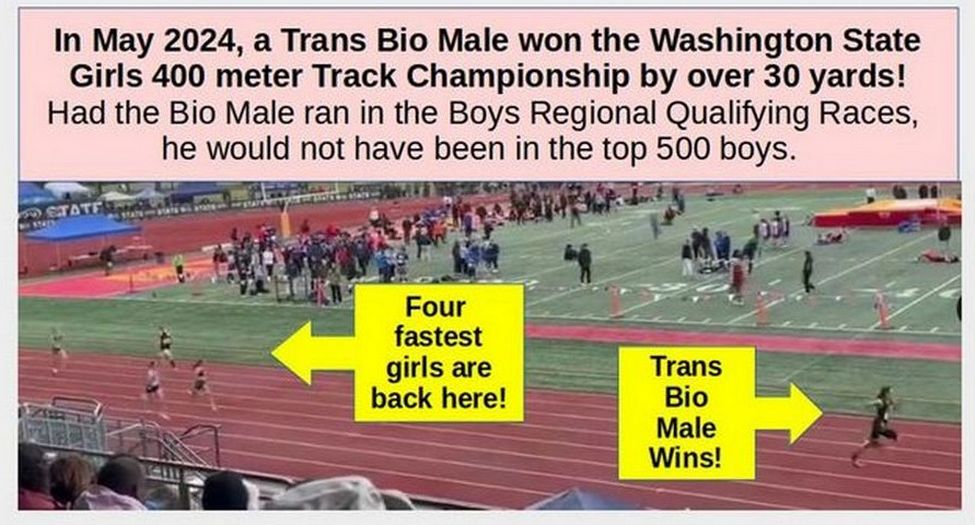
Title IX is a 54 year old federal law to end discrimination against biological girls and protect their right to equal opportunities in educational and athletic programs that receive federal funding. Due to huge biological differences between males and females, this right requires providing girls their own private spaces and sports leagues. Sadly, leaders in Washington state have violated this right by allowing biological males to compete in girls sports leagues and enter girls private spaces. This has resulted in boys winning girls regional and state championships. It has also forced thousands of parents to pull their girls out of public schools in order to protect them from this shocking harm.
In 2024, the Biden administration attempted to dramatically change Title IX without a vote by Congress. About 26 states objected to this change and several federal courts blocked the change. One of these was a ruling called Tennessee v Cardona – a ruling which the US Supreme Court upheld in August 2024. On January 9, 2025, the judge in this case issued a national order requiring all 50 states to comply with the original meaning of Title IX.
Sadly, the leaders of Washington state refused to comply with the either the 2024 Supreme Court ruling or the 2025 federal order. Therefore, on February 28, 2025, the Washington Parents Network was forced to file a 99 page Title IX complaint with the US Department of Education. You can read this complaint on our website at the following link:
https://washingtonparentsnetwork.com/news/washington-parents-network-title-ix-complaint
Washington Parents Network Civil Rights Complaint #2: Against the Seattle Office of the US Department of Education for violating the Title IX Civil Rights of a half million girls in our state
Our Title IX complaint was forwarded to the Seattle Branch of the US Department of Education, which sadly failed to respond to our complaint. Therefore, in March 2025, I visited the Seattle Branch of the Department of Education.
Despite the fact that this branch employed 25 people, there was almost no one at this office. Just row after row of empty cubicles. The one person who answered the door was openly hostile to my request for information about our complaint. Therefore, on March 21, 2025, I filed an additional Title IX complaint with the US Department of Education against the Seattle Branch of the US Department of Education. You can read this complaint at the following link: https://washingtonparentsnetwork.com/news/seattle-office-of-civil-rights-ignores-title-ix-federal-court-order
I also reached out to Washington State Congressman, Dan Newhouse, who is working with several groups here in Washington state attempting to enforce Title IX. Congressman Newhouse is working with DOJ leader, Pam Bondi who has promised to investigate all of our complaints. However, I have learned that what is needed is a new US Attorney – but the appointment of this new US attorney is being blocked by Washington Senator Patty Murray who has threatened to use a “Blue Slip” policy to block that appointment. This issue is discussed in Section 2.
I have also learned that, even if the current “acting” US attorney, Pete Serrano, was to investigate and file a official complaint in federal court, there would likely be legal problems with the complaint since the Serrano appointment is more than 120 days old. This issue is discussed in Section 3. In the meantime, the Title IX rights of over 500,000 girls continue to be violated here in Washington state.
Washington Parents Network Civil Rights Complaint #3: Against Washington State Superintendent of Public Instruction for violations of Title VI of the Civil Rights Act of 1964 (Title VI) and the Equal Protection Clause of the 14th Amendment to the US Constitution
On April 18, 2025, the Washington Parents Network filed a Title VI Civil Rights Discrimination 64 page complaint under the U.S. Department of Education’s Office for Civil Rights’ (OCR) Complaint Resolution Process against the Washington State Superintendent of Public Instruction for requiring all 295 school districts in Washington state to discriminate against over one million students on the basis of race, color or national origin in programs or activities that receive Federal financial assistance in violation of both Title VI of the Civil Rights Act of 1964 (Title VI), 42 U.S.C. § 2000d et seq., and the Equal Protection Clause of the 14th Amendment to the US Constitution. You can read this complaint at this link: https://washingtonparentsnetwork.com/news/washington-parents-network-title-vi-complaint
Our Title VI complaint is based on a 2023 US Supreme Court decision called Students v Harvard. On June 29, 2023, the US Supreme Court published a 237 page landmark decision in the case of Students for Fair Admission v Harvard which clarified that Title VI and the Equal Protection Clause of the 14th Amendment requires “color blindness” in all federal, state and local programs. The Supreme Court concluded that Title VI prohibits any programs or activities that included “racial preferencing” or dividing people up based on skin color.
Racial preference educational programs have many names including but not limited to Critical Race Theory, Ethnic Studies – and most recently – Diversity, Equity and Inclusion or DEI.
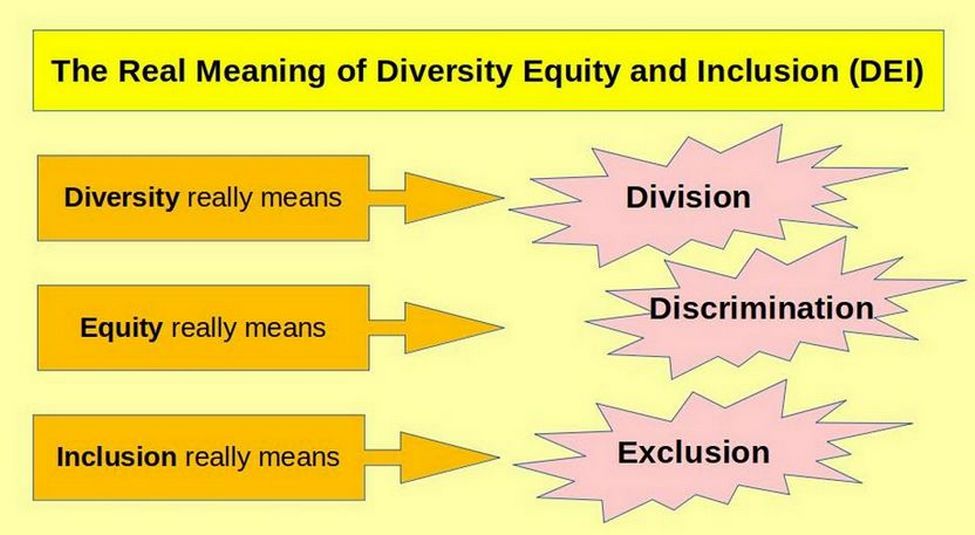
What matters is not the name of the program but whether the program divides people up based on the color of their skin. Any educational program that divides people up based on the color of their skin is a violation of Title VI of the Civil Rights Act of 1964.
On January 20, 2025, based on the 2023 Supreme Court ruling in Students for Fair Admission v Harvard, President Trump issued a Presidental Order “Ending Radical and Wasteful Government DEI Programs and Preferences.”
On January 21, 2025, again citing Students for Fair Admission v Harvard, President Trump issued a Presidential Order “Ending Illegal Discrimination and Restoring Merit Based Opportunities.“
On February 14, 2025, based on these Presidential Orders, which were based on Students for Fair Admission v Harvard, the US Department of Education Office of Civil Rights (OCR) issued a Dear Colleague Letter requiring all state and local education agencies to comply with Title VI and the Equal Protection Clause.
On March 1, 2025, the Office for Civil Rights (OCR) released a Frequently Asked Questions 10 page document providing further guidance on OCR’s February 14, 2025, “Dear Colleague” letter. Here are quotes from the March 1, 2025 OCR FAQ:
“In Students v. Harvard, the Supreme Court reiterated that “discrimination that violates the Equal Protection Clause of the Fourteenth Amendment committed by an institution that accepts federal funds also constitutes a violation of Title VI.”
“Many schools have advanced racially discriminatory policies and practices under the banner of “DEI” initiatives… Schools may not operate policies or programs under any name that intentionally treat students differently based on race, engage in racial stereotyping, or create hostile environments for students of particular races.”
“The First Amendment rights of students, faculty, and staff, and the curricular prerogatives of states and local school agencies do not relieve schools of their Title VI obligations to refrain from creating hostile environments through race-based policies and stereotypes.”
On April 3, 2025, the OCR sent letters to State Commissioners overseeing K-12 State Education Agencies requiring them to certify their compliance with their anti-discrimination obligations under Students v Harvard in order to continue receiving federal financial assistance.
On April 8, 2025, Washington superintendent, Chris Reykdal, issued a press release refusing to comply with the OCR Certification letter. Reykdal falsely claimed that Students v Harvard only applied to “college admissions policies.“ Reykdal further falsely claimed that Washington educational programs already “met the requirements under Title VI.”
In our complaint, we explained why Students v Harvard applies to all programs that receive federal funding. We also provide 30 examples of why Reykdal’s DEI programs willfully and pervasively violate the Title VI rights of students, parents and school board members.
We asked the Office of Civil Rights to conduct a Directed Investigation of Washington state illegal DEI programs and to withhold federal funds until Reykdal agrees to permanently end these DEI programs.
As with our two Title IX complaints, our Title VI complaint requires an investigation and prosecution by the US Department of Justice, which in turn requires having a US attorney here in Washington state. Sadly, this is not likely to happen as long as Senator Patty Murray is allowed to use the Blue Slip policy to prevent the appointment of a US attorney here in Washington state. This issue is covered in greater detail in Section 2.
While the Department of Justice has appointed “acting” US attorneys for Washington state, the legality of these appointments is currently being litigated in the Ninth Circuit (and three other federal circuits) – a topic covered in greater detail in Section 3.
In the meantime, the Title VI rights of over one million students in Washington state are being violated and will continue to be violated until this Constitutional Crisis is resolved.
Washington Parents Network Civil Rights Complaint #4: Against Washington State Superintendent of Public Instruction for violating the Family Educational Rights and Privacy Act (FERPA) rights of hundreds of thousands of parents
On May 9, 2025, the Washington Parents Network filed a FERPA Civil Rights 56 page complaint with the U.S. Department of Education’s Student Privacy Policy Office (SPPO) against the Washington Superintendent of Public Instruction for requiring all 295 school districts in Washington state to force teachers and administrators to keep secret from parents who request important educational records about their children, including the gender transitioning and drug addiction of their children, in programs that receive Federal funding in violation of the Family Educational Rights and Privacy Act (FERPA). Here is a link to this complaint:
https://washingtonparentsnetwork.com/parents-rights/washington-parents-network-ferpa-complaint
On April 30, 2025, the US Office of Education announced that their DOE/DOJ Joint Civil Rights Taskforce was launching a Directed Investigation into the Washington State Superintendent's Office. Here is a link to this Press Release: https://www.ed.gov/about/news/press-release/title-ix-special-investigations-team-launches-directed-investigation-washington-state-superintendents-office-0
Here is a quote from this Press Release: “The Investigation Comes Amid Reports that Washington State Policies Conflict with Title IX, FERPA, and PPRA…Today’s investigation into Washington OSPI is a first-of-its-kind, bringing together ED and DOJ, and multiple offices within ED, to adjudicate several potential violations of federal law.”
in our complaint, we provided evidence that during the past 8 years, OSPI, in conjunction with the radical leaders of the Washington state legislature, have threatened several school districts. Attempts by school districts to comply with FERPA by providing parents with accurate and complete disclosure of a students educational records has led to many school districts receiving severe warning letters from OSPI that they must immediately stop providing parents with accurate and complete records or risk losing state funding.
We provided summaries from four school districts, but we have been told by school board directors than more than 20 school districts have received threatening letters from OSPI due to their attempts to comply with Title IX. The exact number of school districts to receive threatening letters is not known due to secrecy policies at OSPI.
In addition, OSPI has required a series of “secrecy policies,” such as Policy 3211, that force all school district administrators and teachers in Washington state to keep a “Double Set of Student Records” in order to deliberately violate the FERPA rights of parents to receive accurate and complete educational records of their students.
In addition, on April 24, 2025, the Washington legislature passed House Bill 1296, which increased penalties for school districts that refuse to keep a “Double Set of Books” in order to hide important educational records from parents.
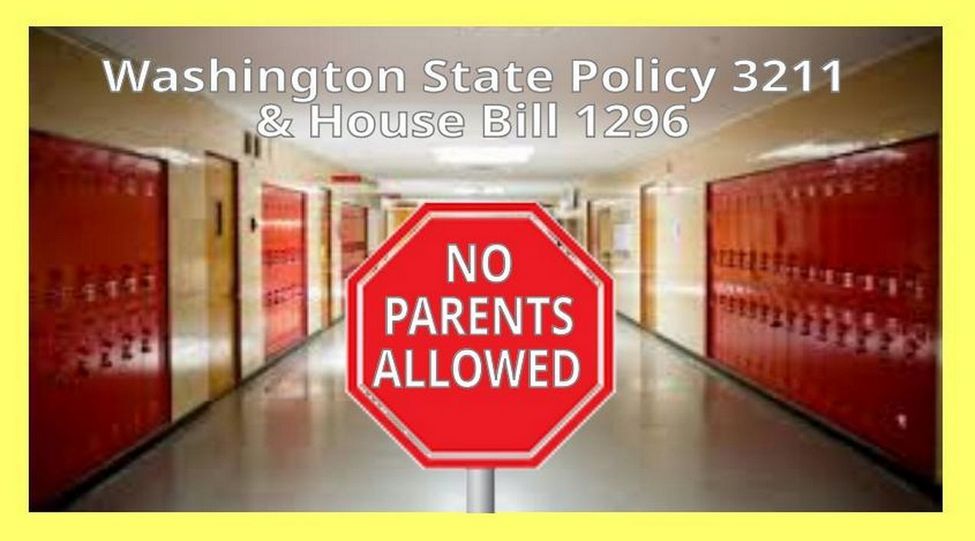
House Bill 1296 and Policy 3211 both violate a recent US Supreme Court Parents Rights ruling called Mahmoud v. Taylor.
Both also violate a December 2025 Ninth Circuit District Court 52 page ruling in a case called Mirabelli v Olson. Here is the link:
https://www.documentcloud.org/documents/26426903-benitez-order/
Our complaint is also supported by a recent 38 page Parents Rights complaint filed against the Seattle School District with the US Department of Justice by a Parents Rights group called Defending Education which is available at this link:
https://defendinged.org/wp-content/uploads/2025/12/Seattle-OCR-Complaint_Final_Updated12.16.25.pdf
As with our two Title IX complaints and our Title VI complaint, our FERPA complaint requires an investigation and prosecution by the US Department of Justice, which in turn requires having a US attorney here in Washington state. Sadly, this is not likely to happen as long as Senator Patty Murray is allowed to use the Blue Slip policy to prevent the appointment of a US attorney here in Washington state. This issue is covered in greater detail in Section 2.
While the Department of Justice has appointed “acting” US attorneys for Washington state, the legality of these appointments is currently being litigated in the Ninth Circuit (and three other federal circuits) – a topic covered in greater detail in Section 3.
In the meantime, the FERPA rights of hundreds of thousands of parents here in Washington state are being violated and will continue to be violated until this Constitutional Crisis is resolved.
Washington Parents Network Civil Rights Complaint #5: Against Washington State Governor Bob Ferguson for violating Federal Election Laws
On September 5, 2025, the Washington Parents Network filed a complaint with the US Department of Justice Voting Section providing evidence that the Washington State Department of Licensing, under the direction of Governor Bob Ferguson, had illegally registered hundreds of thousands of non-citizens to vote here in Washington state. Here is a link to this complaint: https://washingtonparentsnetwork.com/news/complaint-against-bob-ferguson-for-violating-federal-election-laws
As with our two Title IX complaints, our Title VI complaint and our FERPA complaint, our Voting Rights Complaint requires an investigation and prosecution by the US Department of Justice, which in turn requires having a US attorney here in Washington state. Sadly, this is not likely to happen as long as Senator Patty Murray is allowed to use the Blue Slip policy to prevent the appointment of a US attorney here in Washington state. This issue is covered in greater detail in Section 2.
While the Department of Justice has appointed “acting” US attorneys for Washington state, the legality of these appointments is currently being litigated in the Ninth Circuit (and three other federal circuits) – a topic covered in greater detail in Section 3.
In the meantime, the voting rights of every citizen here in Washington state are being violated and will continue to be violated until this Constitutional Crisis is resolved.
Washington Parents Network Civil Rights Complaint #6: Against Washington State Planned Parenthood for violating Federal Trade Commission laws and regulations
On September 19, 2025, the Washington Parents Network filed a 60 page complaint with the Federal Trade Commission via the FTC Gender Affirming Care Comment page against Washington State Planned Parenthood for violating Federal Trade Commission laws and regulations. Here is a link to this complaint:
https://washingtonparentsnetwork.com/news/complaint-against-washington-state-planned-parenthood
Planned Parenthood promotes toxic Trans Drugs as “Gender Affirming Care” by falsely claiming that these drugs can magically “transition” children from one biological sex to the other sex despite the fact that there are at least 6,500 genetic differences between the sexes and no drugs are able to change a child from one sex to the other. A more accurate term for these drugs is “Gender Mutilation Child Abuse.” In our complaint, we provided evidence that thousands of children and their families here in Washington state have been severely and permanently harmed by these fraudulent Planned Parenthood practices.
We also provided a summary of the financial harm to parents and tax payers who are forced to pay for the Planned Parenthood Money Laundering operation – not only through millions of dollars in higher state and federal taxes to pay for Medicaid billings – but also through higher Health Insurance Premiums as the Health Insurance companies are forced to pay millions of dollars each year for Planned Parenthood’s fraudulent billings.
Finally, we provided a summary of legal cases against Planned Parenthood – cases confirming that Planned Parenthood has repeatedly broken federal laws including illegally selling body parts of aborted fetuses and continuing to offer their “services” even after they were ordered to shut down.
As with our two Title IX complaints, our Title VI complaint and FERPA complaint and our Voting Rights Complaint, our Medical Fraud complaint requires an investigation and prosecution by the US Department of Justice, which in turn requires having a US attorney here in Washington state. Sadly, this is not likely to happen as long as Senator Patty Murray is allowed to use the Blue Slip policy to prevent the appointment of a US attorney here in Washington state. This issue is covered in greater detail in Section 2.
While the Department of Justice has appointed “acting” US attorneys for Washington state, the legality of these appointments is currently being litigated in the Ninth Circuit (and three other federal circuits) – a topic covered in greater detail in Section 3. In the meantime, the rights of thousands of children and parents here in Washington state to accurate medical information are being violated and will continue to be violated until this Constitutional Crisis is resolved.
Washington Parents Network Civil Rights Complaint #7: Against Washington State Election Officials for violating Federal Election laws prohibiting online voting
On January 8, 2026, the Washington Parents Network filed a 21 page complaint with the Voting Rights Division of the US Department of Justice providing evidence that Washington state has recently allowed and continues to allow insecure online vote curing in violation of federal election laws. This insecure election process is being used in the most populous county in Washington state, King County, to automatically “cure” some - but not all - of the ballots whose signatures were challenged by election workers. This new online voting system app currently being used in Washington state - called Omniballot - does not meet federal election system testing standards because it is inherently not secure and therefore violates federal election laws. Using an online voting system violates the right of every citizen in Washington state to fair elections.
Here is a link to our seventh complaint:
https://washingtonparentsnetwork.com/news/complaint-against-washington-state-online-voting
As with our two Title IX complaints, our Title VI complaint, our FERPA complaint, our Voting Rights Complaint and our Medical Fraud complaint, our online voting complaint requires an investigation and prosecution by the US Department of Justice, which in turn requires having a US attorney here in Washington state. Sadly, this is not likely to happen as long as Senator Patty Murray is allowed to use the Blue Slip policy to prevent the appointment of a US attorney here in Washington state. This issue is covered in greater detail in Section 2.
While the Department of Justice has appointed “acting” US attorneys for Washington state, the legality of these appointments is currently being litigated in the Ninth Circuit (and three other federal circuits) – a topic covered in greater detail in Section 3. In the meantime, the rights of thousands of children and parents here in Washington state to accurate medical information are being violated and will continue to be violated until this Constitutional Crisis is resolved.
Summary of our previous 7 complaints
Taken together, our 7 complaints provide evidence of a war against the civil rights of parents and our children here in Washington state – violation of important rights – violations that have been inflicted on families in our state for years – ongoing violations of our rights an epic scale – violations of numerous constitutional rights, numerous federal laws and numerous US Supreme Court rulings - violations that requires urgent investigation by the US Department of Justice. But violations that will continue because there are no Senate approved US attorneys in Washington state – and have not been for the past year – all because Washington Senator, Patty Murray, is using an unconstitutional Blue Slip policy to block a vote on a US attorney for Washington state. This monstrous obstruction of justice can not be allowed to continue.
In the next two sections, we will review the unconstitutional Blue Slip actions of the US Senate this past year – and the steps taken by the US Department of Justice to overcome the Senate Blue Slip policy.
Section 2 Statutory Construction Analysis of Article II Section 2
The most important rule of statutory construction is that, if the words of a provision are clear, the provision should to be interpreted using the plain meaning of the words in the provision - as those meanings were understood at the time that the provision was written. The second most important rule of legal analysis is that provisions should be interpreted in a manner that gives meaning to every word of the provision. In this article, we will review every word of Article II Section 2 of the US Constitution to support our assertion that the plain meaning of Article II Section 2 of the US Constitution requires the President to nominate each Officer defined by Congress and that the Senate is required to hold an up or down vote for each and every Presidential nomination if that nomination is not clearly covered by one of the three alternate approval options provided for Article II, Section 2. Therefore, any Senate Rule, written or unwritten (such as the Senate Blue Slip Policy) that is used to block a vote on a Presidential Nomination is an unconstitutional violation of Article II, Section 2.
Here is the complete text of Article II Clause 2 - Advice and Consent:
“He shall have Power, by and with the Advice and Consent of the Senate, to make Treaties, provided two thirds of the Senators present concur; and he shall nominate, and by and with the Advice and Consent of the Senate, shall appoint Ambassadors, other public Ministers and Consuls, Judges of the supreme Court, and all other Officers of the United States, whose Appointments are not herein otherwise provided for, and which shall be established by Law: but the Congress may by Law vest the Appointment of such inferior Officers, as they think proper, in the President alone, in the Courts of Law, or in the Heads of Departments.”
Because we are not concerned here with the Presidential Power to make Treaties, appoint Ambassadors, Ministers, Consuls or Judges, we will only review the following words:
“He shall... nominate, and by and with the Advice and Consent of the Senate, shall appoint... all other Officers of the United States, whose Appointments are not herein otherwise provided for, and which shall be established by Law: but the Congress may by Law vest the Appointment of such inferior Officers, as they think proper, in the President alone, in the Courts of Law, or in the Heads of Departments.”
The word “Shall” creates a Binding Legal Obligation
Here is the legal meaning of the word “Shall” from the Cornell Law School:
“Shall is an imperative command, usually indicating that certain actions are mandatory, and not permissive. This contrasts with the word “may,” which is generally used to indicate a permissive provision, ordinarily implying some degree of discretion.”
Here is the definition from LegalClarity.org:
“In legal contexts, “shall” is often used to signal a mandatory requirement or duty. Some legal systems specifically define the word in an imperative sense, indicating that a particular action must be performed. When used in this way, the term is intended to create the following: A mandatory duty; A binding legal obligation: A requirement that leaves little or no room for personal choice.”
Having reviewed both the records of the US Constitutional Convention and the Federalist Papers that led to the ratification of the US Constitution as well as other writings of James Madison, I am certain that the drafters of Article II, Section 2 understood that the word “shall” created a binding legal obligation” for the President to nominate Officers and for the Senate to take action to provide Advice and Consent. As we explain below, the word Consent requires an up or down vote of each Presidential nominee.
The word “Consent” in the term “With the Advice and Consent” requires an Up or Down Vote
The words Advice and Consent are rooted in English Common Law to meant that the actions of the King are not official without a vote of approval by the Parliament. In the United Kingdom, a constitutional monarchy, bills are headed:
“BE IT ENACTED by the King's most Excellent Majesty, by and with the advice and consent of the Lords Spiritual and Temporal, and Commons, in this present Parliament assembled, and by the authority of the same, as follows:”
This enacting formula emphasizes that although legally the bill is being enacted by the British monarchy, it is only with a vote to signify the approval of Parliament that the bill becomes an official law.
As used in Article II, Section 2, the word “advice” can have more than one meaning. The two most common meanings are to “recommend” or to “deliberate.” While there have been many articles on the what the word Advice means, the most detailed historical analysis is from the following article published in 2018 by the Federalist Society:
“As Franklin’s words suggest, whether the recommendatory or deliberative meaning was intended could be deduced from the context. A very important contextual factor was the presence or absence of the preposition with. That preposition usually signaled the deliberative meaning. Thus, in Samuel Johnson’s famous dictionary, the second definition for the verb “advise” was “To consider; to deliberate.” The third definition for the noun “advice” was “Consultation; deliberation: with the particle with.” See Samuel Johnson, A Dictionary of the English Language (6th ed. London, 1785)
The 2018 Federalist article goes to great lengths to provide more than 20 historical examples to support their claim that the word “Advice” means “deliberative. But in a nutshell, if the word “advice is preceded by the word “with”, then the meaning of “advice is “to deliberate.” That is why the constitutional phrase usually rendered “Advice and Consent” is better rendered “with the Advice and Consent.”
Because the full phrase in Article II, Section 2 includes the word “with”, then the word “with” must also be given meaning. According to a 1785 dictionary, the word “with” means to use the “Deliberation” meaning. If the word “advice is preceded by the word “with”, then the meaning of “advice is “to deliberate.” That is why the constitutional phrase usually rendered “Advice and Consent” is better rendered “with the Advice and Consent.”
Several writings by Madison and Hamilton also confirm that the word “advice” is to mean “deliberation” by the Senate and not to “recommend” a nominee. Thus, the “deliberative meaning of the word Advice means that the Senate Judiciary Committee will hold a Confirmation hearing where they will deliberate (in other words, consider the pros and cons of) the Presidential Nominee.
The Second step of the term “With the Advice and Consent” is an Up or Down vote
The key to understanding the entire phrase “With the Advice and Consent” is that it includes two separate steps. The first step is Advice in the form of a deliberative hearing. The second step is Consent which requires an Up or Down vote. There is no other way to arrive at the Consent of the majority of the full Senate.
Thus, the word “Consent” has only one very clear meaning. The Senate has only two options. They can vote to approve the nomination or they can vote against the nomination (Both Madison and Hamilton said exactly this in the Federalist Papers). This vote should be a public vote so the voters know who to blame should the nominee be approved or not approved.
Why the Single Senator Veto (aka Blue Slip Policy) violates the meaning of Advice and Consent
Equally bad, the blue slip policy collapses the distinction between advice and consent. Genuine advice consists of deliberation prior to nomination, and vetting of candidates through public hearings. The president is free to heed or ignore that advice. Consent comes later when the Senate votes publicly on the nomination. The blue slip merges these stages and permits a single senator to veto even a potential nominee with no recorded vote.
The word “Senate” refers to a majority vote of the entire Senate and does not refer to a single Senator
It is very clear from the writings of several drafters of the US Constitution that they never dreamed of a “Blue Slip” unwritten Senate Policy that would give a single Senator the ability to prevent the Advice and Consent process from even occurring in the first place.
Quotes from the Federalist Papers on the meaning and purpose of the Appointments Clause
There is no need to guess or wonder what our Founding Fathers had in mind when they wrote the US Constitution back in 1787. This is because the provisions in the Constitution were explained in detail by the Federalist Papers which were a series of 85 essays published in New York newspapers between 1787 and 1788 and written by Alexander Hamilton, James Madison and John Jay about the meaning of the proposed US Constitution. These essays explained the principles on which the new federal system was based and answered several questions about how it functioned. They covered several topics like the need for separation of powers, checks and balances and why a strong federal government was required for the preservation of liberty. They can be read at the following link: https://guides.loc.gov/federalist-papers/full-text
The essays explain that the existing lack of a strong federal government has led to all kinds of problems. After the Revolutionary War, each state adopted its own Constitution and differences between these state constitutions caused conflicts harming economic growth. There was a national legislature. But it had no power because there was no national executive or judicial branch. The new proposed US Constitution would solve this problem by creating a strong executive branch and a strong judicial branch. It was clear from the essays that the drafters felt that the greatest danger was the legislative branch. Thus several provisions were added to the US Constitution in an attempt to insure “separation of powers” – which would limit the ability of Congress to take over or control the Executive or Judicial branch.
This is why it is certain that the drafters of the US Constitution would have strongly opposed the Senate Blue Slip Policy as well as Section 541, Section 546 and the NVRA.
The following are quotes from the Federalist Papers confirming that the drafters of the US Constitution wanted a strong federal government and would have opposed Congressional a One Senator Veto of Presidential Nominees and would have opposed allowing Congress to manipulate the appointment process by imposing a series of additional conditions.
The Appointments Clause, Article 2, Section 2, Clause 2 was explained in the following passage:
FEDERALIST NO. 66 (Alexander Hamilton): “It will be the office of the President to NOMINATE, and, with the advice and consent of the Senate, to APPOINT. There will, of course, be no exertion of CHOICE on the part of the Senate. They may defeat one choice of the Executive, and oblige him to make another; but they cannot themselves CHOOSE, they can only ratify or reject the choice of the President.... Thus it could hardly happen, that the majority of the Senate would feel any other complacency towards the object of an appointment than such as the appearances of merit might inspire, and the proofs of the want of it destroy.”
Why a majority vote is required:
Federalist 54 (Madison): “under the proposed Constitution, the federal acts will take effect . . . on the majority of votes in the Federal Legislature… In all cases where justice or the general good might require new laws to be passed, or active measures be pursued, the fundamental principle of free government would be reversed. It would no longer be the majority that would rule; the power would be transferred to the minority.”
Why the legislative branch should not be trusted: Federalist No. 49: “We have seen that the tendency of republican governments is to an aggrandizement of the legislative at the expense of the other departments.”
Why Congress should not be allowed to take over the Executive branch:
Federalist No. 51: “The Structure of the Government Must Furnish the Proper Checks and Balances Between the Different Departments… Each department should have a will of its own; and consequently should be so constituted that the members of each should have as little agency as possible in the appointment of the members of the others… As the weight of the legislative authority requires that it should be thus divided, the weakness of the executive may require, on the other hand, that it should be fortified.”
Federalist No. 70 (Alexander Hamilton): “A feeble Executive implies a feeble execution of the government. A feeble execution is but another phrase for a bad execution; and a government ill executed, whatever it may be in theory, must be, in practice, a bad government.”
As further proof that the focus was on limiting the power of Congress and protecting the right of the Executive Branch, the following link has a history of how Article II, Section 2, Clause 2.
https://press-pubs.uchicago.edu/founders/documents/a2_2_2-3s1.html
It shows that on June 13th Madison stated that he:
“objected to an appt. by the whole Legislature. Many of them were incompetent Judges of the requisite qualifications. They were too much influenced by their partialities. “
On June 18th, 1787, Madison proposed:
“The supreme Executive authority of the United States . . . to have the sole appointment of the heads or chief officers of the departments of Finance, War and Foreign Affairs; to have the nomination of all other officers (Ambassadors to foreign Nations included) subject to the approbation or rejection of the Senate.”
On July 18th, Mr. Ghorum stated:
“ The Executive would certainly be more answerable for a good appointment, as the whole blame of a bad one would fall on him alone.”
On July 21st, 1787, during the Constitutional Convention, Madison stated:
“that he was not anxious that 2/3 should be necessary to disagree to a nomination. He had given this form to his motion chiefly to vary it the more clearly from one which had just been rejected. He was content to obviate the objection last made, and accordingly so varied the motion as to let a majority reject.”
On September 7th, 1787, near the end of the Constitutional Convention, Governor Morris said: “as the President was to nominate, there would be responsibility, and as the Senate was to concur, there would be security. As Congress now make appointments there is no responsibility.”
After this observation, the “with the Advice and Consent” part of the Appointments Clause was passed.
Statutory Analysis of the Exceptions Clause of Article II, Section 2
The Exception clause was added to end of the Appointments clause near the very end of the Constitutional Convention. On September 15, 1787, Governor Morris moved to add:
"but the Congress may by law vest the appointment of such inferior Officers as they think proper, in the President alone, in the Courts of law, or in the heads of Departments."
Mr Sherman seconded the motion.
Mr. Madison protested that “It does not go far enough if it be necessary at all--Superior Officers below Heads of Departments ought in some cases to have the appointment of the lesser offices.”
A vote was then held on the motion and the motion failed due to the vote being a tie. After further discussion, which was unable to address the request of Mr. Madison to grant the right of Superior Officers the right to make appointments of lesser officers, a second vote was held on the original Morris motion and this time, the original motion passed.
To understand why US attorneys should not be subject to the Senate Blue Slip process, we begin with the US Constitution. Article II, section 2, clause 2 of the United States Constitution provides that the president "shall nominate, and by and with the Advice and Consent of the Senate, shall appoint... all other Officers of the United States, whose Appointments are not herein otherwise provided for, and which shall be established by law; but the Congress may by Law vest the Appointment of such inferior Officers, as they think proper, in the President alone, in the Courts of Law, or in the Heads of Departments.
According to a 2012 study by the Congressional Research Service, there are between 1,200 and 1,400 civilian officers of the US which are subject to the "advice and consent" of the Senate prior to commissioning.
As we covered earlier, the meaning of the term “advice” is to hold a public hearing. The meaning of the term “consent” is to require a public vote with a simple majority vote of the Senate providing consent. The policy of allowing a single Senator to use a Blue Slip to block consideration of a nominee is clearly contrary to the intent of these two terms.
As for the meaning of “Inferior officers,” in Edmond v. United States (1997) the US Supreme Court stated that "'inferior Officers' are officers whose work is directed and supervised at some level by others who were appointed by presidential nomination with the advice and consent of the Senate."
Since US Attorneys are under the supervision of the Attorney General, who is subject to the Senate Advice and Consent process, US Attorneys are “inferior” officers. Thus, Congress has exactly three additional options:
Congress may vest the appointment of US Attorneys “in the President alone, in the Courts of Law, or in the Heads of Departments.”
Note that the word “MAY” means that Congress does not need to vest the appointment of US attorneys in the President alone, the Courts or the Heads of Departments.
If Congress fails to vest the appointment in one of these three ways, the default process, according to the US Supreme Court is that “inferior officers” are subject to the Senate Advice and Consent process.
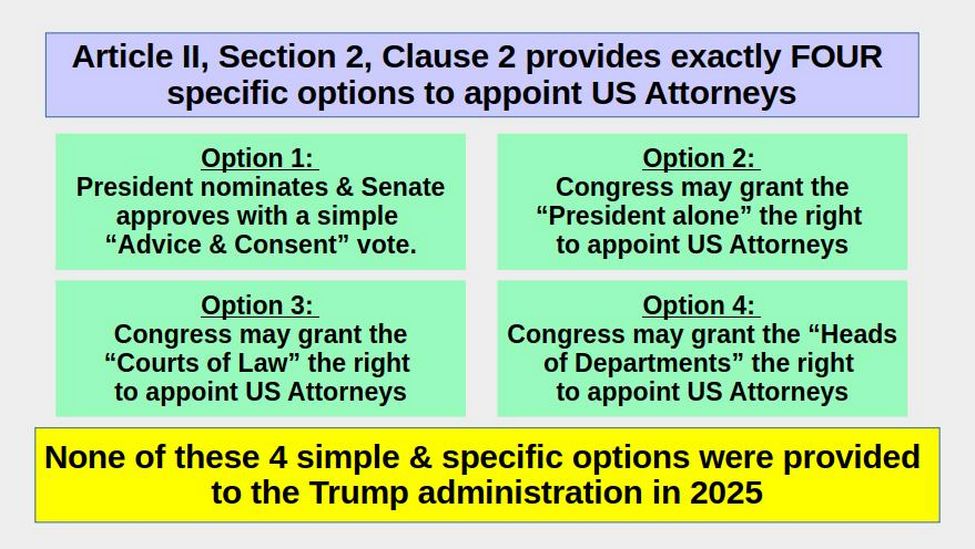
Also note that, if Congress wants to vest the appointment of Inferior Officers, the word “OR” means that Congress has four mutually exclusive options. These options are:
Option #1: President Nominates & Senate approves with simple Advice and Consent vote.
Option #2: The President Alone appoints – with no conditions.
Option #3: The Courts of Law appoint – with no conditions.
Option #4: The Heads of Departments (such as the head of the US Department of Justice who is also known as the Attorney General) appoints – with no conditions.
As a result of the Senate Blue Slip policy, there are now many districts where one or more members of the Senate refuse to even allow the Advice and Consent process to start. The term “Senate” in Article II, Section 2, Clause 2 clearly means the entire Senate – not just a single Senator. The will of the entire Senate can not be determined without a vote and the will of the Senate is determined by the affirmative vote of the majority of the Senate.
To the extent that the Blue Slip policy prevents the Senate from fulfilling its “advice and consent” mandatory duty, which in turn results in even a single district not having a US Attorney, the Blue Slip policy is unconstitutional. At a minimum, the “advice and consent” process must require a hearing before the Senate Judicial Committee and a vote of the US Senate. The Blue Slip policy acts to obstruct the vote of the Senate and leaves it unclear to the voters who is to blame for the fact that they do not have a US Attorney in their district.
Section 3 Why the National Vacancies Reform Act is Unconstitutional
“There is a good deal of wiggle-room as to what an earlier case “holds…What I think is needed, however, is not rationalization of this process but abandonment of it… The text is the law, and it is the text that that must be observed… By trying to make the Constitution do everything that needs doing from age to age, we shall have caused it to do nothing at all.” Supreme Court Justice Anthony Scalia, 1995
Justice Scalia argued that courts should interpret statutes and the Constitution based on their original public meaning rather than allowing judges to adapt the law to new values, as is often done in traditional common law. It is understandable that the Supreme Court is extremely reluctant to overturn a Senate Policy – even an unwritten policy like the Blue Slip. The Supreme Court is also extremely reluctant to overturn a federal law such as the NVRA. But when that policy and or that law severely harms the civil rights of millions of Americans, the Supreme Court must defend the plain meaning of the US Constitution.
In our original complaint, we briefly stated as an obvious fact that the National Vacancies Reform Act (NVRA) was unconstitutional because it was extremely complex and added all kinds of obstacles that were clearly contrary to the plain and simple meaning of Article 2, Section 2, Clause 2. In this new Section of our Amended Complaint, we will go into greater detail and provide more evidence that the NVRA is unconstitutional.
But before we do that, we need to explain why a 2014 US Supreme Court decision, called NLRB v. Canning - which grossly misinterpreted the plain meaning of Article 2, Section 2, Clause 3 must be corrected. This is essential because Article 2, Section 2 must be understood in its entirety as an inter-related process. Article 2, Section 2, Clause 3 is directly related to and dependent on Article 2, Section 2 Clause 1 and Clause 2. This issue is so important that our complaint assumes that this ruling will be overturned and that the correct historical and plain meaning of Article II, Section 2, Clause 2 will be restored.
And before we do that, we need to explain the context of the series of events that led up to the Constitutional Convention as this will help clarify why our Founders wrote what they wrote and what the purpose of Article 2, Section 2 was.
Historical Context of Article 2, Section 2
The lead up to the Constitutional Convention all started about one hundred years before the Constitutional Convention. The fore-fathers of our Founders came over from England and in nearly every case they had a written Charter from the King that gave them the right to form their own governments.
Things went well for about 80 years. Then Parliament passed five laws called the Intolerable Acts that essentially revoked the Charters and the right of the colonists to self government. The Colonists appeals to the English Courts and the King both of which sided with Parliament. This is essentially what led to the Revolutionary War. The key think is that our Founders felt betrayed and developed a severe hatred for Parliament, the English Courts and the King.
So when the Founders created a new government, they wrote the Articles of Confederation so that the Congress or national government had no power and there was no national courts or executive branch. There were only 13 independent state legislatures.
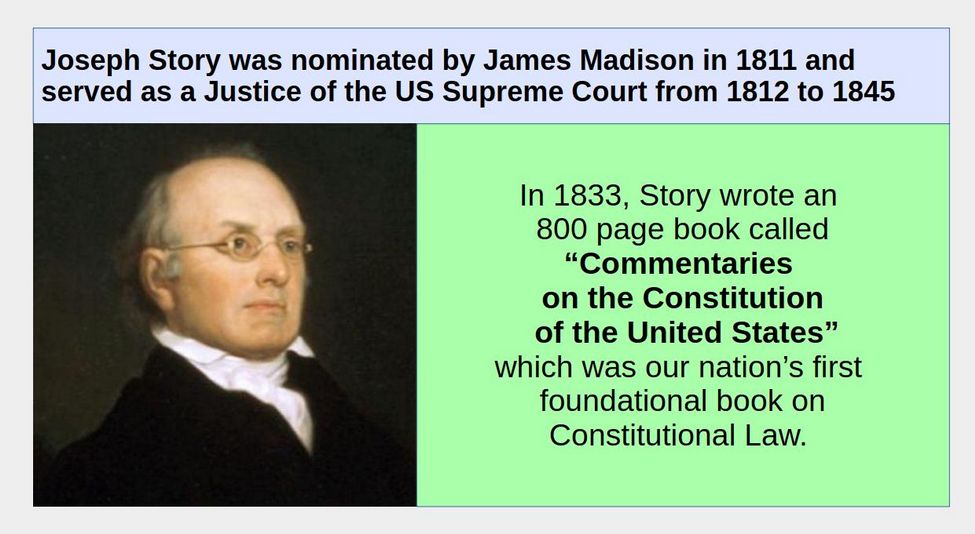
The background of and problems with the Articles of Confederation were well documented by Joseph Story whose father, Dr. Elisha Story, was one of the “Sons of Liberty” who participated in the Boston Tea Party in 1773. Story was nominated to the Supreme Court by James Madison and served on the US Supreme Court from 1812 to 1845 where he wrote the landmark opinion in Martin v. Hunter’s Lessee (1816), affirming the US Supreme Court’s power over state Supreme courts. In this opinion, Story wrote:
"The Constitution of the United States was ordained and established not by the States in their sovereign capacities, but emphatically, as the preamble of the Constitution declares, by 'the people of the United States.”
Story cited the Constitution's assertion to be "The supreme law of the land" and that "Judges in every state shall be bound thereby".
Story also taught courses in Constitutional Law at Harvard University. In 1833, Story published an 800 page book called Commentaries on the Constitution of the United States, our nation’s first foundational text in American constitutional law. This book is now in the Public Domain and can be downloaded in either PDF or EPUB from this link.
His massive book also included a detailed summary of many of the significant events leading up to the drafting of the US Constitution. Each paragraph in this book was given a number.
Here is his description on the events leading up to the signing of the Declaration of Independence. Paragraph 205 states in part:
“On the 7th of June, 1776, certain resolutions respecting independency were moved, which were referred to a committee of the whole. On the 10th of June it was resolved; that a committee be appointed to prepare a declaration, "that these united colonies are, and of right ought to be, free and independent states; that they are absolved from all allegiance to the British crown; and that all political connection between them and the state of Great Britain is, and ought to be, dissolved." On the 11th of June a committee was appointed to prepare and digest the form of a confederation to be entered into between the colonies, and also a committee to prepare a plan of treaties to be proposed to foreign powers. On the 28th of June the committee appointed to prepare a Declaration of Independence brought in a draft. On the 2d of July, congress adopted the resolution for Independence; and on the 4th of July they adopted the Declaration of Independence.”
A year after the Declaration of Independence, Congress signed the Articles of Confederation. Here are a few quotes from Story’s describing the problems with this document, which he referred to as a “Treaty” between independent states:
“Decline and Fall of the Articles of Confederation 1777 to 1781”
“They were suddenly brought together, not so much by any deliberate choice of a permanent union, as by the necessity of mutual cooperation and support in resistance of the measures of Great Britain. They found themselves, after having assembled a general congress for mutual advice and encouragement, compelled by the course of events to clothe that body with sovereign powers in the most irregular and summary manner, and to permit them to assert the general prerogatives of peace and war, without any previous compact, and sanctioned only by the silent acquiescence of the people. Under such circumstances each state felt, that it was the true path of safety to retain all sovereign powers within its own control, the surrender of which was not clearly seen, under existing circumstances, to be demanded by an imperious public necessity.”
“The principal powers respected the operations of war, and would be dormant in times of peace. In short, congress in peace was possessed of but a delusive and shadowy sovereignty, with little more, than the empty pageantry of office… But they possessed not the power to raise any revenue, to levy any tax, to enforce any law, to secure any right, to regulate any trade, or even the poor prerogative of commanding means to pay its own ministers at a foreign court. They could contract debts; but they were without means to discharge them. They could pledge the public faith; but they were incapable of redeeming it.“
“All powers, which did not execute themselves, were at the mercy of the states, and might be trampled upon at will with impunity… They may make war, and determine what number of troops are necessary; but cannot raise a single soldier. In short, they may declare everything, but do nothing.”
“From the moment, that the peace of 1783 secured the country from the distressing calamities of war, a general relaxation took place; and many of the states successively found apologies for their gross neglect in evils common to all… The close of the revolution, independent of the enormous losses, occasioned by the excessive issue and circulation, and consequent depreciation of paper money, found the country burdened with a public debt of upwards of forty-two millions of dollars;28 eight millions of which was due for loans obtained in France or Holland, and the remainder to our own citizens, and principally to those, whose bravery and patriotism had saved their country.”
“Though the colonies had a common origin, and owed a common allegiance, and the inhabitants of each were British subjects, they had no direct political connection with each other. Each was independent of all the others; each, in a limited sense, was sovereign within its own territory. There was neither alliance nor confederacy between them.”
Unfortunately, the Articles of Confederation led to 7 years of political chaos and economic collapse. This in turn led to the understanding that there was a need for a national government with at least some power – including a national executive branch and a national court system. This in turn lead to the Constitutional Convention.
But it is essential to understand that the delegates to this convention still hated Parliament and the English Courts and the King and did not want to create an American version of these three things. The Founders recognized that giving more power to Congress, or the Executive Branch or the Judicial Branch would result in less power, less freedom and less liberty for the People.
So a primary goal of every sentence in the Constitution was to limit the power of Congress, limit the power of the President and limit the power of the Judiciary. Contrary to popular belief, the Founders also wanted to limit the power of the State legislatures because that had seen how dysfunctional those legislatures were.
So it is completely wrong to say that they were only trying to limit the power of the President or limit the power of the Senate. They were trying to limit the power of all three branches because they still hated Parliament, the English Courts and the King.
Article II, Section 2 has Three Inter-related Clauses
Which brings us to Article II, Section 2 which defines how government officers are to be created and appointed. Article II, Section 2 consists of three clauses – which are often discussed separately. But in reality, the three clauses need to be discussed together. In Section 2 of our complaint, we did a word-by-word breakdown of the meaning of Article 2, Section 2, Clauses 1 and 2. In a moment we will get to Article 2, Section 2 Clause 3 which is the Recess Appointments Clause. But first, we need to understand how these three clauses came about.
According to Madison’s account of the Constitutional Convention, as well as the Federalist Papers, there was a great deal of debate about how federal offices were to be created and appointed. The delegates from small states wanted the newly envisioned Senate to do this job. But the delegates from big states, including Madison, wanted the President to do the job. A compromised was reached where the President did the nomination and the Senate provided Advice and Consent by holding a public vote for or against the nominee. In addition, the power to create federal offices was divided between all three branches whereby Congress would create the offices, the President would sign off on the new law and the Courts would review whether the new law complied with the Constitution. The reason for the compromise was to get the support of not only delegates from both small and large states – but also to increase the odds that both small and large states would ratify the new Constitution. The drafters hoped that this system of Separation of Powers and Checks and Balances would work to limit the Power of each branch and thereby preserve as much as possible, the rights and freedom of the People.
Initially, as of the first week of September, only Article II, Section 2, Clause 1 existed. But several delegates including Madison were not happy. They were concerned about what would happen as our nation grew and there were more federal officers needing confirmation. Requiring the Senate to confirm every single officer was not practical. So they offered an Amendment giving Congress the power, when they created new offices for Inferior Officers, to make the appointment process for Inferior Officers easier and not subject to Senate Approval. During the second week of September, they offered and passed the following amendment which became Clause 2 or the Vesting Clause: “but the Congress may by Law vest the Appointment of such inferior Officers, as they think proper, in the President alone, in the Courts of Law, or in the Heads of Departments.”
The key thing about this clause is that Congress has the right to create any Inferior Officers they want. But neither the President or the Judiciary has the right to create any Inferior Officers. Congress also has the right to choose one and only one of the options above for the appointment of each of these Inferior Officers. Congress can decide for example to have one type of Inferior Officer to be appointed by the President and other group to be appointed by the Heads of Departments and other type of Inferior Officers appointed by the Courts.
But if Congress does not choose one of these 3 specific options, then the Inferior Officer must go through the Senate Advice and Consent process.
Congress can also amend their own laws to change the appointment of any group of officers from being appointed in one way to being appointed in a different way. So if one Congress likes the President, they can change the law to let the President appoint all Inferior Officers. Or if Congress hates the President, they can have the Courts appoint all Inferior Officers.
But there are three things Congress can not do. The first is that Congress can not pass a law allowing Principal Officers to evade the Senate Advice and Consent Process. Principal Officers are the Heads of Departments who have significant and independent decision making power.
The second thing Congress cannot do is limit who the President nominates for an Office. The role of the Senate is merely to approve or disapprove of a nominee through an up or down vote.
The third thing Congress can not do is come up with an Obstacle Course appointment process that had all kinds of road blocks, provisions and timelines to give Congress more power to control the nomination process and hold the President hostage. This is why the Senate Blue Slip policy is unconstitutional. It is also why the NVRA is unconstitutional. Congress is specifically limited to one and only one of the three options in Article II Section 2 for the appointment of each Inferior Officer. Again, the point here is to limit the power of Congress and limit the power of the President.
A key question is why there were three options in Article II, Section 2 and not 2 options or 4 options? The answer, as was the case with most of the provisions of the Constitution is that it was a compromise and an effort to get the votes of more delegates from various states. For example, Massachusetts did not have a separate court system. Their state legislature was their court system. So they trusted the legislature and not the Courts. Delegates from other states had more trust in their court system and less trust in their legislature. To keep all of the delegates to the Convention happy, each of the three preferred options were allowed.
Which leads us to Article II, Section 2, Clause 3 – the Recess Appointments Clause. Some delegates were still not happy. They were concerned about what would happen to the function of the executive branch if the Senate was not around to provide advice and consent.
While the Senate did not yet exist, it was envisioned that the Senate would only meet for a few months out of each year. So near the end of the Constitutional Convention, they offered the following amendment which became Clause 3:
“The President shall have Power to fill up all Vacancies that may happen during the Recess of the Senate, by granting Commissions which shall expire at the End of their next Session.”
We do not know much about this Clause because according to Joseph Story’s 1833 book on the Constitutional Convention, the Amendment passed without any discussion. What we do know is that the “Sessions of Congress” occurred once a year. By Recess, they meant the six months or so when Congress was not in session. This was clearly explained in Story’s 1833 book. Here is what Story wrote about the meaning and purpose of Article II, Section 2, Clause 3 beginning at paragraph 1550:
“This clause [2.2.3] was not in the first draft of the constitution; but was afterwards inserted by an amendment, apparently without objection… There was but one of two courses to be adopted; either, that the senate should be perpetually in session, in order to provide for the appointment of officers; or, that the president should be authorized to make temporary appointments during the recess, which should expire, when the senate should have had an opportunity to act on the subject. The former course would have been at once burdensome to the senate, and expensive to the public. The latter combines convenience, promptitude of action, and general security… The appointments so made, by the very language of the constitution, expire at the next session of the senate; and the commissions given by him have the same duration. “
“The language of the clause is, that the president shall have power to fill up vacancies, that may happen during the recess of the senate… By "vacancies" they understood to be meant vacancies occurring from death, resignation, promotion, or removal. The word "happen" had relation to some casualty, not provided for by law. If the senate are in session, when offices are created by law, which have not as yet been filled, and nominations are not then made to them by the president, he cannot appoint to such offices during the recess of the senate, because the vacancy does not happen during the recess of the senate. “
Thus, under Article II, Section 2, Clause 3, the President can appoint anyone they want, but the appointment will automatically expire at the end of the next Congressional Session. The reason the temporary appointment expired at the end of the session instead of the beginning was because they assumed the President would nominate either the new person or someone else to go through the Senate Advice and Consent process. Or if the law specified,, that an Inferior Officer would be appointed by the new President, the new Department Head or the new Court people. In either case, it would take time for the President or the Head of a Department to find someone to fill the vacancy. The key thing was it was an annual process that assumed their might be new people in every new Session of Congress.
Another key point was that there was no wiggle room. The Appointment process was very precisely defined. There was a single process for Principal officers and three other options for Inferior Officers. Then there was a separate process to cover emergency situation when Congress was not in session. The reason the Drafters did not create a more open ended process was because they did not trust either Congress or the President. So they defined a precise series of steps and options to limit the power of both the President and Congress.
Why the 2014 Supreme Court Decision NLRB v. Canning needs to be corrected
There are at least seven reasons for hoping that the Supreme Court will agree to overturn this ruling.
First and foremost, this Clause 3 ruling failed to take into account the adverse effect it has on Clause 1 and Clause 2. Because it allows the President to make new Recess appointments whenever needed, it renders both Clause 1 and 2 to be meaningless.
This is a problem because Article II, Section 2 is one of the most important sections in the entire Constitution. The drafters left a lot of things undefined – including the Judiciary and the Bill of Rights – both of which were left to the First Congress. But the Appointment Process was so important that it was precisely spelled out. The 2014 ruling essentially overturned the entire apple cart. This 2014 ruling has to be overturned or nothing else in our complaint matters.
The second reason for hope is that the 2014 ruling goes directly against Story’s explanation of the meanings of “session” and “vacancy” in his foundational 1833 book on Constitutional Law.
The third reason for hope is that the 2014 Supreme Court ruling was a 5 to 4 ruling. All it takes is for one or two Supreme Court Justices to realize that a mistake was made in the 2014 ruling in order to fix this problem.
The fourth reason is that all we are asking for is a return to the original plain meaning of Article II Section 2 so that all three clauses can be brought back into harmony. Whenever we promote “possible” meanings instead of “plain” meanings, and claim that words are ambiguous when they are in fact clear as day, in order to justify unconstitutional practices, we will eventually find ourselves not only up a creek without a paddle, but over a cliff and heading for a hard landing. The road to Hell is paved with good intentions.
The fifth reason is that the 2014 decision was the first time the Supreme Court has made a ruling on the meaning of Article 2, Section 2, Clause 3. So reversing this one decision will return to the Constitutional Appointments framework of Article 2, Section 2.
The sixth reason is that overturning the 2014 incorrect ruling will help clarify why the NVRA also needs to be overturned for nearly identical reasons.
The final reason is that the author of the Dissenting Opinion, Justice Scalia, clearly spelled out the serious problem with the majority decision. So all that is really needed when petitioning the Supreme Court is to quote Justice Scalia. We include a few quotes from his Dissent below.
The Case and Question
On January 4, 2012, while the Senate was still in session but taking a few day holiday break, President Obama abused the Recess Clause Article II, Section 2, Clause 3 to appoint three new members to the National Labor Relations Board (NLRB). These three appointments were challenged in Court. The Supreme Court correctly ruled that the appointments violated Article II, Section 2, Clause 3. But the majority ruling misinterpreted the meaning of the word “Recess.” The majority opinion also misinterpreted the meaning of the word “Vacancy.” In a concurring Opinion, Justice Scalia with the support of Justices Roberts, Thomas and Alito, provided more accurate definitions of the terms “Recess” and “Vacancy”.
Here are a few quotes from Justice Scalia’s Dissent:
“Except where the Constitution or a valid federal law provides otherwise, all “Officers of the United States” must be appointed by the President “by and with the Advice and Consent of the Senate.” U. S. Const., Art. II, §2, cl. 2.”
“To prevent the President’s recess-appointment power from nullifying the Senate’s role in the appointment process, the Constitution cabins that power in two significant ways. First, it may be exercised only in “the Recess of the Senate,” that is, the intermission between two formal legislative sessions. Second, it may be used to fill only those vacancies that “happen during the Recess,” that is, offices that become vacant during that intermission.”
“The majority sweeps away the key textual limitations on the recess-appointment power. It holds, first, that the President can make appointments without the Senate’s participation even during short breaks in the middle of the Senate’s session, and second, that those appointments can fill offices that became vacant long before the break in which they were filled. To reach that result, the majority casts aside the plain, original meaning of the constitutional text in deference to late-arising historical practices.”
“The bedrock principle that “the constitutional structure of our Government” is designed first and foremost not to look after the interests of the respective branches, but to “protect individual liberty.”
“Since the separation of powers exists for the protection of individual liberty, its vitality “does not depend” on “whether ‘the encroached-upon branch approves the encroachment.’ ”
“Rather, policing the “enduring structure” of constitutional government when the political branches fail to do so is “one of the most vital functions of this Court.”
“Likewise, when the charge is made that a practice “enhances the President’s powers beyond” what the Constitution permits, “it is no answer . . . to say that Congress surrendered its authority by its own hand.”
“Past practice does not, by itself, create power… Political branches cannot by agreement alter the constitutional structure.”
Plain Meaning
“A sensible interpretation of the Recess Appointments Clause should start by recognizing that the Clause uses the term “Recess” in contradistinction to the term “Session.”
“As Alexander Hamilton wrote: “The time within which the power is to operate ‘during the recess of the Senate’ and the duration of the appointments ‘to the end of the next session’ of that body, conspire to elucidate the sense of the provision.” The Federalist No. 67”
“In the founding era, the terms “recess” and “session” had well-understood meanings in the marking-out of legislative time. The life of each elected Congress typically consisted (as it still does) of two or more formal sessions separated by adjournments.”
“As one scholar has thoroughly demonstrated, “in government practice the phrase ‘the Recess’ always referred to the gap between sessions.” Natelson, The Origins and Meaning of “Vacancies that May Happen During the Recess” in the Constitution’s Recess Appointments Clause, 37 Harv. J. L. & Pub. Pol’y 199, 213 (2014) (hereinafter Natelson); see id., at 214–227 (providing dozens of examples). “
“The Constitution’s use of “the word ‘the’ in ‘the Recess’ ” tends to suggest “that the phrase refers to the single break separating formal sessions.”
“If “the next Session” denotes a formal session, then “the Recess” must mean the break between formal sessions… the “Recess” and the “Session” to which the Clause refers are mutually exclusive, alternating states. The Federalist No. 67, at 455 (explaining that appointments would require Senatorial consent “during the session of the Senate” and would be made by the President alone “in their recess”);”
“Vacancies occurring “during the recess of the Senate” with those occurring “during the session of the Senate”); 2 Op. Atty Gen. 525, 527 (1832) (discussing a vacancy that “took place while the Senate was in session, and not during the recess”). It is linguistically implausible to suppose—as the majority does—that the Clause uses one of those terms… (“Recess”) informally and the other (“Session”) formally in a single sentence, with the result that an event can occur during both the “Recess” and the “Session.”
“The majority’s reading yields the strange result that an appointment made during a short break near the beginning of one official session will not terminate until the end of the following official session, enabling the appointment to last for up to two years.
“To preserve the Senate’s role in the appointment process—which the founding generation regarded as a critical protection against “ ‘despotism,’ ” Freytag, 501 U. S., at 883—by clearly delineating the times when the President can appoint officers without the Senate’s consent.”
“It is inconceivable that the Framers would have left the circumstances in which the President could exercise such a significant and potentially dangerous power so utterly indeterminate. Other structural provisions of the Constitution that turn on duration are quite specific.”
“Any officers appointed in those circumstances would have served under a cloud, unable to determine with any degree of confidence whether their appointments were valid.”
“The fact that the Constitution includes a 3-day limit in one clause but omits it from the other weighs strongly against finding such a limit to be implicit in the clause in which it does not appear. In all events, the dramatically different contexts in which the two clauses operate make importing the 3-day limit from the Adjournments Clause into the Recess Appointments Clause “both arbitrary and mistaken.”
“The historical practice of the political branches is, of course, irrelevant when the Constitution is clear. But even if the Constitution were thought ambiguous on this point, history does not support the majority’s interpretation.”
“1789 to 1866: During those eight decades, Congress must have taken thousands of breaks that were 3 days or shorter. On the majority’s reading, every one of those breaks would have been within the Clause’s text—the majority’s newly minted limitation not yet having been announced. “Yet there is no record of anyone, ever, having so much as mentioned the possibility that the recess appointment power was activated during those breaks.”
“More than half a century went by before any other President made an intra-session recess appointment, and there is strong reason to think that during that period neither the Executive nor the Senate believed such a power existed. For one thing, the Senate adjourned for more than 3 days 45 times during that period, and 43 of those adjournments exceeded 10 days. Yet there is no evidence that a single appointment was made during any of those adjournments or that any President before the 20th century even considered making such appointments.. The structural interests protected by the Appointments Clause are not those of any one branch of Government but of the entire Republic.”
Pre-Recess Vacancies
“The recess-appointment power is limited to vacancies that arise during the recess in which they are filled. I would hold that the appointments at issue here—which undisputedly filled pre-recess vacancies—are invalid for that reason as well as for the reason that they were made during the session.”
“As the majority concedes, “the most natural meaning of ‘happens’ as applied to a ‘vacancy’ . . . is that the vacancy ‘happens’ when it initially occurs… a vacancy that happened during the Recess was most reasonably understood as one that arose during the recess.”
“The unilateral power conferred on the President by the Recess Appointments Clause was therefore understood to be “nothing more than a supplement” to the “general method” of advice and consent.”
“In 1792, Attorney General Edmund Randolph, who had been a leading member of the Constitutional Convention, provided the Executive Branch’s first formal interpretation of the Clause. He advised President Washington that the Constitution did not authorize a recess appointment to fill the office of Chief Coiner of the United States Mint, which had been created by Congress on April 2, 1792, during the Senate’s session. Randolph wrote: “Is it a vacancy which has happened during the recess of the Senate? It is now the same and no other vacancy, than that, which existed on the 2nd. of April 1792. It commenced therefore on that day or may be said to have happened on that day.”
“The Pay Act, which provided that “no money shall be paid . . . out of the Treasury, as salary, to any person appointed during the recess of the Senate, to fill a vacancy . . . which . . . existed while the Senate was in session… The Pay Act would remain in force without significant modification for nearly eight decades.”
“The real tragedy of today’s decision is not simply the abolition of the Constitution’s limits on the recess appointment power and the substitution of a novel framework invented by this Court. It is the damage done to our separation-of-powers jurisprudence more generally. It is not every day that we encounter a proper case or controversy requiring interpretation of the Constitution’s structural provisions. Most of the time, the interpretation of those provisions is left to the political branches—which, in deciding how much respect to afford the constitutional text, often take their cues from this Court. We should therefore take every opportunity to affirm the primacy of the Constitution’s enduring principles over the politics of the moment. “
Summary of the Scalia Dissent
Scalia provided more than enough evidence to conclude that the original plain meaning of Article II, Section 2, Clause 3 requires that the word “Recess” means the gap between one legislative session and another legislative session – and that the meaning of the word “Vacancy” means a vacancy that occurs during the Recess – and does not include any vacancy that occurred before the Recess.
To Scalia’s many points, we should add one more important point: The only way to properly understand the plain meaning of Article II, Section 2, Clauses 1 and 2 is to use the plain meaning of Clause 3. It is essential that all three clauses be read in a way that creates harmony for all three clauses. This is why throughout our complaint (which is mainly about enforcing Article II, Section 2, Clauses 1 and 2), we will assume that NLRB v. Canning will be overturned.
Why the National Vacancies Reform Act (NVRA) is Unconstitutional
Now that we have a more accurate understanding of the plain meaning of the word “Vacancy”, we are ready to explain why the NVRA is unconstitutional. The latest version of the NVRA was passed in 1998. It amended a version of the Vacancies Act passed in 1988 which was an amended version of the Vacancies Act which was passed in 1891 which was an amended version of the Vacancies Act which was passed in 1868 which in turn was an amended version of the Vacancies Act which was passed in 1795 which was an amended version of the original Vacancies Act which was passed in 1792. We will cover the changes beginning with the original version.
The Second Congress passed a Vacancies Act on May 8, 1792 authorizing the president to temporarily appoint acting officials. Amazingly, this Act gave the President an unlimited amount of time to keep “Acting” Officials in office. It read as follows:
“In case of the death, absence from the seat of government, or sickness of the Secretary of State, Secretary of the Treasury, or of the Secretary of the War department, or of any officer of either of the said departments whose appointment is not in the head thereof, whereby they cannot perform the duties of their said respective offices, it shall be lawful for the President of the United States, in case he shall think it necessary, to authorize any person or persons at his discretion to perform the duties of the said respective offices until a successor be appointed, or until such absence or inability by sickness shall cease.” Act of May 8, 1792, ch. 37, § 8, 1 Stat. 281.
Some, including the erroneous Majority Opinion in NLRB v. Canning, have claimed that since the first Vacancies Act was passed in 1792 by many of the same people who wrote the Constitution, then the 1792 Act was constitutional and all subsequent versions of the Vacancies Act were constitutional. Nothing could be further from the Truth. It is essential to understand who the President was back in 1792. It was George Washington – our nation’s first and greatest President – and a person who was deeply respected and trusted in a way that no other President has ever been trusted. This is a guy who was unanimously elected to be the President of the Constitutional Convention – and the guy properly credited with winning the Revolutionary War and being the “Father of our Nation”.
The Congress in 1792 would have done whatever George wanted – regardless of the Constitution. As just one example, the first Congress took less than one day to pass all of his nominations. The reason it was unconstitutional to give the President an unlimited amount of time to appoint a replacement in the case of a vacancy was that it violated Article II, Section 2, Clause 3 which limited the time for emergency appointments to the end of the next session of Congress.
In 1795, the Third Congress made two amendments to fix two problems with the first Vacancy Act: First, the phrase “death, absence from the seat of government, or sickness” was replaced with the more general term “vacancy” – meaning any vacancy for any reason.
Second, Congress added a provision that “no one vacancy shall be supplied, in manner aforesaid, for a longer term than six months.” Vacancy Act of Feb. 13, 1795.
Here is the complete text of the 1795 Vacancy Act:
“Be it enacted by the Senate and House of Representatives of the United States of America in Congress assembled, That in case of vacancy in the office of Secretary of State, Secretary of the Treasury, or of the Secretary of the department of War, or of any officer of either of the said departments, whose appointment is not in the head thereof, whereby they cannot perform the duties of their said respective offices; it shall be lawful for the President of the United States, in case he shall think it necessary, to authorize any person or persons, at his discretion, to perform the duties of the said respective offices, until a successor be appointed, or such vacancy be filled: Provided, That no one vacancy shall be supplied, in manner aforesaid, for a longer term than six months. “
Note that the first two versions of the Vacancy Act did not require that the person serving as an “Acting” officer be either the First Assistant or Top Assistant or even any other person confirmed by the Senate. Instead, both versions read: “any person or persons at his discretion to perform the duties of the said respective offices.”
The reason this was important is because it was well understood that Congress did not have the power under the Constitution to tell the President who he could or could not appoint any more than Congress could tell the President who to nominate. The Third Congress of 1795 consisted of 30 Senators and 104 Representatives. Many of these 134 members of Third Congress were either delegates to the Constitutional Convention or had been mentored by delegates to the Constitutional Convention. They all knew that the power of the Senate was merely to hold an up or down vote on a nominee that the President had chosen. This was clearly stated in several articles of the Federalist Papers.
By clarifying the time limit problem os the first Vacancy Act and bringing it into alignment with Article II, Section 2, Clause 3, the second Vacancy Act was now in compliance with the US Constitution. It is significant that Joseph Story and the early US Supreme Court agreed as they better understood the original meaning of the Constitution than we do today.
Why the 1868 Vacancies Act was Unconstitutional
The 1795 Vacancy Act stayed in effect until 1868 when there was a fight between Andrew Johnson and Congress. The 1868 Vacancies Act required, for the first time, that all acting officers chosen by the president must be either the first assistant to the vacant office or an already confirmed federal officer - in other words have been confirmed by the Senate to some other office. We refer to this as the “First Assistant” rule.
The First Assistant Rule is clearly unconstitutional because was (and still is) an attempt by Congress to limit who the President may choose to serve in his Administration. There are several articles in the Federalist Papers stating clearly that the Senate’s role was to provide an up or down vote on Presidential nominees – not to choose who may or may not be approved or to place any other obstacles in the path of the President.
The First Assistant Rule is also unconstitutional because it has the effect ignoring the result of an Election that results in a change of administration – as the First Assistant is a member of the Administration that was voted out of office. The new President must have the Power to appoint whoever they want in order to advance the policies and promises they had made to the voters during the previous year’s Presidential Election.
However, the 1868 version of the First Assistant Rule might be thought at the time that it was constitutional since it would merely insure a smooth transition of power from the old to the new administration and was limited to a period of only 10 days. Specifically, the 1868 Vacancies Act divided vacancies into two categories with different rules for each category. The word “Acting” was defined to mean when the secretary was still in office but temporarily sick or traveling. There was no time limit for a person to be an “Acting” person as they were only temporarily filling in for the real Officer – who could fix any mistakes when they came back. (See Government Printing Office, Trial of Andrew Johnson 585–88 (1868). The second category, which is more like what we might think of as being a vacancy was called an “Interim” Officer – which was an Officer who filled the gap between when one Senate Approved Permanent Officer left office and another Senate Approved Permanent Officer was confirmed by the Senate. An Interim Officer was limited to 10 days under the assumption that it would take the Senate no more than 10 days to confirm them. See Act of July 23, 1868, ch. 227, § 3, 15 Stat. 168.
1891 The Slippery Slope begins
In 1891, the Vacancies Act was amended again. This time, the Interim Officer was increased from 10 days to 30 days supposedly to fix the problem that the Senate was having trouble approving a new person in just 10 days. Under the theory of “what a typical person might think was a reasonable period of time”, it is possible that a temporary Interim Officer serving for 10 days or even 30 days might still comply with Article II, Section 2 provided that the President had nominated someone for the vacant office and that the Senate was going to hold hearings and a vote on the nominee within 30 days of the vacancy. In other words, as long as a Good Faith attempt was being made by the President and by the Senate to comply with their mandatory Appointment obligations as required by Article II, Section 2. The First Assistant Rule was also retained meaning that the US Attorney of the old Administration could remain in power for 30 days.
1988 The Slippery Slope steepens
Sadly, in 1988, the Vacancy Act was amended again. This time, the limit was increased to from 30 days to 120 days (which is about 4 months). This increase to 120 days may appear to be Constitutional since the 1795 Congress had allowed a period of 6 months (or 180 days). But the crucial difference was that the 1795 Congress enabled the election to have meaning by allowing the President to appoint anyone they wanted during the 180 day period.
The First Assistant rule, which was retained in 1988, had the effect of taking power away from the new President for up to 120 days. The idea that a Presidential Transition might be delayed for 120 days is clearly an unconstitutional obstruction of the new President.
1998 The Slippery Slope goes over the cliff with the NVRA
In 1998, Congress amended the Vacancy Act again. The Federal Vacancies Reform Act of 1998 (NVRA) changed the name from Interim Officer to “Acting” Officer and increased the time limit from 120 days to 210 days. This is 7 months. Plus other conditions that increased the time limit all the way up to 300 days (10 months) during the Presidents First term in office. The flimsy excuse given for this clear violation of Article II, Section 2 is that we have an extremely dysfunctional Senate which might take a year or more to hold a hearing and a vote on a Presidential Nominee.
So we have gone from the Senate taking one day to approve a nominee to the Senate taking a year or more to approve a nominee. In fact, there have been many Presidential Nominees that NEVER get voted on by the Senate. The Senate even has a rule than any Presidential nominees that do not get a vote by the end of December are automatically removed from the list and must be re-nominated in January of the next year (at least that is the Senate rule for US Attorneys which is what our complaint is all about).
Comparing Five Versions of the Vacancy Act
Here is a graph of the five versions of the Vacancies Act showing how these time limits have increased over time. I have placed the final two versions in red as being clearly unconstitutional and two other versions in orange as being likely unconstitutional since they include the “First Assistant” rule but make merely a minor limit in the President’s ability to choose their own Administration:
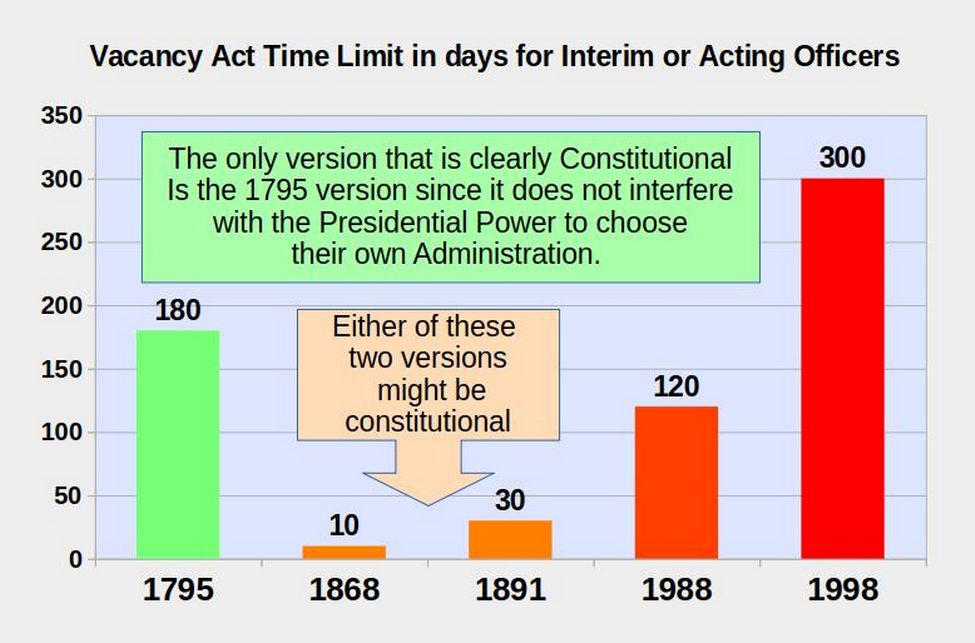
The FVRA is the most unconstitutional of all of the versions of the Vacancy Act because it adds a huge list of obstacles and conditions – none of which are in compliance with the Article II, Section 2. Here is a link to a PDF of the FVRA in case you want to read. This Frankenstein Monster is 11 pages long! Because the NVRA is nearly unreadable, we will attempt to put some of the basic parameters into more normal English:
If a federal officer whose appointment was made through the Senate process is unable to perform the functions of their office, then:
(1) the First Assistant of the office shall perform the duties of the office for up to 210 to 300 days.
(2) the President may temporarily appoint a different person who has gone through the Senate process to perform the duties of the vacant office.
(3A) the President may temporarily appoint someone who has not been through the Senate process if during the year before the vacancy occurred, the person served as an employee of the office for at least 90 days.
(4) A person may not serve an an acting officer if the President submits a nomination of such person to the Senate
(5) Any actions taken by an official not temporarily appointed in compliance with the NVRA has no effect.
Here is a graphic representation of the various time periods in the NVRA:
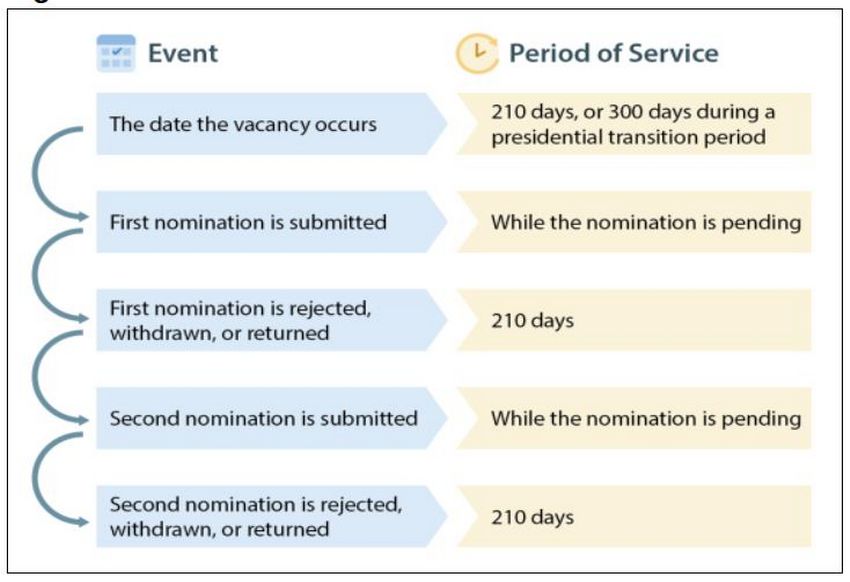
There are many more conditions of the NVRA which we will not get into. But just based on the above, there are several serious problems.
The biggest problem is that the First Assistant Rule is not only contrary to Article II, Section 2, but when the election results in a change of Presidential Administration from one political party to the opposing political party, the First Assistant rule could render the actual election to be meaningless as the First Assistant was appointed and aligned with the agenda of the administration that lost the election. Such a person is likely to actively oppose the agenda of new Administration. The same goes for appointing someone from the office who has been there 90 days or more during the preceding year.
This rule gives Senators from the opposing party a huge incentive to use their Blue Slip to oppose any Presidential nominee, no matter how well qualified, to keep the prior Officers in place for as long as possible so that they can sabotage the new administration.
So the NVRA not only violates the simple plain terms of Article II, Section 2, it violates the basic principle that elections should matter. The NVRA encourages Senators to prevent the Advice and Consent process and the long period of time encourages a new President to avoid the Advice and Consent process. The Act gives a newly inaugurated President a “blank check” for appointments during the first 300 days of his first term. The Act authorizes a newly elected President to appoint acting officers to every advice and consent position in the executive branch for up to 300 days. In other words, the Act effectively empowers a new President to staff and run the executive branch for almost an entire year without subjecting any acting appointees to confirmation.
In 2017, the Supreme Court issued a 43 page ruling related to the NVRA. The case was called National Labor Relations Board V. SW General. The Justices struggled with the complexity of the NVRA. In the oral argument for this case, Justice Kagan questioned the lawyer representing SW General. She suggested that the company should go to the press and say the NLRB violated the Act: “Who wouldn’t say that in that circumstance?”
The lawyer replied: “Somebody who then was going to be pressed and had to explain the technicalities of why the appointment was illegal.” The courtroom erupted in laughter.
Justice Thomas wrote a concurring Opinion in which he pointed out some Constitutional problems with the 1998 NVRA:
“I write separately to explain my view that the Appointments Clause likely prohibited Solomon’s appointment. The Appointments Clause prescribes the exclusive process by which the President may appoint “officers of the United States.” United States v. Germaine, 99 U. S. 508, 510 (1879); accord, Buckley v. Valeo, 424 U. S. 1, 132 (1976) (per curiam) (“All officers of the United States are to be appointed in accordance with the Clause . . . . No class or type of officer is excluded because of its special functions”). It provides that the President “shall nominate, and by and with the Advice and Consent of the Senate, shall appoint ... all other Officers of the United States, whose Appointments are not herein otherwise pro- vided for, and which shall be established by Law: but the Congress may by Law vest the Appointment of such inferior Officers, as they think proper, in the President alone, in the Courts of Law, or in the Heads of Departments.” U. S. Const., Art. II, §2, cl. 2.”
“For purposes of appointment,” the Clause divides all officers into two classes—“inferior officers” and noninferior officers, which we have long denominated “principal” officers. Germaine, supra, at 509, 511. Principal officers must be appointed by the President by and with the advice and consent of the Senate. See Edmond v. United States, 520 U. S. 651, 660 (1997). That process “is also the default manner of appointment for inferior officers.” Ibid. But the Clause provides a limited exception for the appointment of inferior officers: Congress may “by Law” authorize the President, the head of an executive department, or a court of law to appoint inferior officers without the advice and consent of the Senate.”
“The FVRA does not, however, require the President to seek the advice and consent of the Senate before directing the official to perform the functions of the vacant office.”
“When the President “directs” someone to serve as an officer pursuant to the FVRA, he is “appointing” that person as an “officer of the United States” within the meaning of the Appointments Clause. Around the time of the framing, the verb “appoint” meant “to establish anything by decree.”
When the President “directs” a person to serve as an acting officer, he is “assigning” that person to serve as an officer.
The FVRA authorizes the President to appoint both inferior and principal officers without first obtaining the advice and consent of the Senate.
Appointing inferior officers in this manner raises no constitutional problems. That is because the Appointments Clause authorizes Congress to enact “Laws,” like the FVRA, “vesting the Appointment of such inferior Officers . . . in the President alone.”
“Appointing principal officers under the FVRA, however, raises grave constitutional concerns because the Appointments Clause forbids the President to appoint principal officers without the advice and consent of the Senate.”
“That the Senate voluntarily relinquished its advice-and-consent power in the FVRA does not make this end-run around the Appointments Clause constitutional. The Clause, like all of the Constitution’s structural provisions, “is designed first and foremost not to look after the interests of the respective branches, but to protect individual liberty.”
“That Solomon was appointed “temporarily” to serve as acting general counsel does not change the analysis. I do not think the structural protections of the Appointments Clause can be avoided based on such trivial distinctions. Solomon served for more than three years in an office limited by statute to a 4-year term, and he exercised all of the statutory duties of that office. 29 U. S. C. §153(d). There was thus nothing “special and temporary” about Solomon’s appointment. United States v. Eaton, 169 U. S. 331, 343 (1898). “
“That the Senate voluntarily relinquished its advice-and consent power in the FVRA does not make this end-run around the Appointments Clause constitutional. The Clause, like all of the Constitution’s structural provisions, “is designed first and foremost not to look after the interests of the respective branches, but to protect individual liberty.. “It is therefore irrelevant that “the encroached-upon branch approves the encroachment… Neither Congress nor the Executive can agree to waive” the structural provisions of the Constitution any more than they could agree to disregard an enumerated right. The Judicial Branch must be most vigilant in guarding the separation between the political powers precisely when those powers collude to avoid the structural constraints of our Constitution.”
Justice Thomas is right to have major concerns about the NVRA.
What is the Remedy… If the NVRA is unconstitutional, what would be a Constitutional solution to the problem of Vacancies?
The Supreme Court is not in the business of writing laws or even amending laws. The Supreme Court’s role is limited to letting Congress know when one or more of their laws violates the US Constitution. While it is up to Congress to decide on a solution to this problem, the Supreme Court can and should provide some guidance that the President can use while waiting for Congress to come up with a long term solution.
Here are four of the Supreme Court’s options:
Option #1: Just declare the 1998 NVRA to be unconstitutional which would roll the law back to the 1988 version of the Vacancies Act.
The problem with this option is that the 1988 Act also allows the Congress to dictate who would be in the new administration for an entire 120 days. Keeping the opponents of the new administration in office for so long would cause grid lock and violate Article II, Section 2. So this is not a good option.
Option #2: Declare both the 1998 and 1988 versions of the Vacancies Act to be unconstitutional.
The option would roll the Vacancies Act back to the 1891 version. This option would only allow the old administration officers to stay in power for 30 days after the new administration was in power. Some might believe this is a practical solution that does not seriously offend Article II, Section 2.
Option #3: Declare the 1998, 1988, 1891 and 1868 versions of the Vacancy Act to be unconstitutional.
This option would roll the Vacancies Act back to the 1795 version. This is the only option that fully honors the plain meaning of Article II, Section 2.
Option #4: Declare all of the versions of the Vacancy Act to be unconstitutional
This option would force Congress to comply with the original options for vacancies as provided for in Article II, Section 2, Clause 3. While this would comply with Article II, Section 2, it might violate other sections of the US Constitution – in particular, the Necessary and Proper Clause, Article I, Section 8, Clause 18 which states: “The Congress shall have Power... To make all Laws which shall be necessary and proper for carrying into Execution the foregoing Powers, and all other Powers vested by this Constitution in the Government of the United States.”
Section 4 Why 28 US Code Sections 541 and 546 are Unconstitutional
One of the first acts of Congress after the ratification of the US Constitution was the Judiciary Act of 1789. The purpose of the Act was to provide a process for enforcing federal laws. To achieve this purpose, the Act required that a US attorney “shall be appointed” for each federal district:
“There shall be appointed in each district a meet person learned in the law to act as attorney for the United States in such district, who shall be sworn or affirmed to the faithful execution of his office, whose duty it shall be to prosecute in such district all delinquents for crimes and offences, cognizable under the authority of the United States, and all civil actions in which the United States shall be concerned.”
The word “shall” means that the action is mandatory. Thus, the appointment of a US attorney for each federal district is not optional. We, as citizens have a right to a US attorney in our district who is charged with enforcing the laws of the United States – including protecting our civil rights. Clearly, something is wrong if we citizens are deprived of a US attorney for years at a time simply because there is a disagreement between the President and one or more Senators.
Constitutional Problems with 28 U.S.C. Section 541 and 28 U.S.C. Section 546
Unfortunately, in recent years, Congress passed several unconstitutional laws including 28 U.S.C. Section 541, 28 U.S.C. Section 546 and the National Vacancy Reform Act (NVRA). We have previously explained why the NVRA is unconstitutional. Here we will explain why 28 US Code 541 and 28 US Code 546 violate the simple framework of Article II, Section 2, Clause 2 of the United States Constitution.
28 U.S.C. Section 541
In 1966, Congress passed 28 U.S.C. Section 541 which includes the following conditions not permitted by the Appointments Clause :
(a) The President shall appoint, by and with the advice and consent of the Senate, a United States attorney for each judicial district.
(b) Each United States attorney shall be appointed for a term of four years. On the expiration of his term, a United States attorney shall continue to perform the duties of his office until his successor is appointed and qualifies.
(c) Each United States attorney is subject to removal by the President.
Constitutional problem with Section 541 (B)
Part B of the Section 541 framework allows the US Attorney from the previous administration to continue in office “until his successor is appointed and qualifies.” This provision suffers from at least 3 problems:
First, it renders the election that led to the change of administration to be meaningless. The whole point of a Presidential Election is to allow the American people to vote on whether they want a different administration. If the American people vote for a change of Administration, like they did in November 2024, the new Administration is suppose to take effect on January 20, 2025. But Section 541B allows the US Attorneys chosen by the former administration to remain in office even though their boss lost the election. These US Attorneys from the prior administration sadly are strongly opposed to the new administration and may even take steps to sabotage the new administration.
Second, this provision gives Senate members of the losing party in the prior election a political incentive to use the Blue Slip process to delay and obstruct the appointment of US Attorneys nominated by the new Administration in order to delay the legal actions and policies of the new Administration from taking effect – with the goal being to “run out the clock” for the entire 4 years of the new administration.
Third and most important, keeping the old administration US Attorneys in office while delaying the appointment of the new administration US Attorneys is not one of the four options provided Article II, Section 2, Clause 2. Section 541B by its very nature is designed to result in gridlock and is therefore unconstitutional.
Why 28 U.S.C. Section 541 is unconstitutional
In addition, as amended on June 14, 2007, Congress passed 28 U.S.C. Section 546 which which includes the following conditions not permitted by the Appointments Clause :
(a) Except as provided in subsection (b), the Attorney General may appoint a United States attorney for the district in which the office of United States attorney is vacant.
(b) The Attorney General shall not appoint as United States attorney a person to whose appointment by the President to that office the Senate refused to give advice and consent.
(c) A person appointed as United States attorney under this section may serve until the earlier of—
(1) the qualification of a United States attorney for such district appointed by the President under section 541 of this title; or
(2) the expiration of 120 days after appointment by the Attorney General under this section.
(d) If an appointment expires under subsection (c)(2), the district court for such district may appoint a United States attorney to serve until the vacancy is filled. The order of appointment by the court shall be filed with the clerk of the court.
Constitutional problem with Section 546
Section 546 is even worse than Section 541. Section 546 adds several additional conditions and limitations which are not specified or in keeping with the simple framework of Article II, section 2, clause 2.
For example, the appointment can only be for 120 days. This time limit condition violates the language of Article II, Section 2, Clause 2. Instead, if Congress wants to give the appointment power to the Attorney General, the appointment power has to be without conditions or time limits.
Section 546 (b) includes the provision that if a person has been rejected by the US Senate, they can not be appointed even temporarily after that. This is the reason why the Trump administration has failed to even submit the nominations of many of their “acting” or “special” US Attorneys to the Senate for consideration. The Trump administration is afraid that their nominees will be railroaded by a single Senator using the Blue Slip process and never even get to an up or down vote in the Senate – and will then not be allowed to serve even temporarily as US Attorneys. Again, this condition clearly violates the simple Framework of Article II, Section 2, Clause 2. Instead, if Congress wants to give the appointment power to the Attorney General, the appointment power has to be without conditions.
Section 546(d) is a Frankenstein provision that transfers the responsibility to appoint US Attorneys to the District Court judges who are supposed to be Independent. This also violates Article II, Section 2, Clause 2 because instead of using one of three options, it creates a fourth “combo” option that divides the appointment process between two different branches.
To add insult to injury, Section 546(d) uses the word “MAY” instead of the word “SHALL.” This means that the District Court judges can decline to appoint a US Attorney – which is exactly what many District Courts have decided to do. But as a result of Section 541 and Section 546, many districts, including both districts in Washington state do not currently have a valid US Attorney with clear authority to investigate crimes, protect civil rights and file complaints in federal courts.
This provision thus also violates the Juudiciary Act which requires that a US Attorney "SHALL" be appointed.
Why neither of these Acts comply with the simple framework of Article II, section 2, clause 2 and are therefore unconstitutional
Together with the NVRA, these three laws place a complex series of obstacles in the way of appointing a permanent and valid US Attorney for each district. To be clear, we are only concerned with the appointment process for US Attorneys for each district – since US Attorneys are an essential tool for enforcing the First Amendment Right of the People to petition the government for redress of grievances and since US Attorneys (unlike federal judges) serve at the discretion of the currently elected President.
Why the Blue Slip policy in combination with Sections 541 and 546 violates the Advice and Consent provision of the US Constitution
The Blue Slip policy violates the Advice and Consent provision of the US Constitution
Article I, Section 5 of the US Constitution states in part:
“Each House may determine the Rules of its Proceedings.”
However, this clause does not allow either the House or the Senate to use rules, written or unwritten, such as the Senate Blue Slip, to violate other sections of the US Constitution.
See, e.g., Vander Jagt v. O’Neill, 699 F.2d 1166, 1170 (D.C. Cir. 1982) (“If Congress should adopt internal procedures which ‘ignore constitutional restraints or violate fundamental rights,’ it is clear that we must provide remedial action.”) (quoting United States v. Ballin, 144 U.S. 1, 5 (1892))
Also see United States v. Ballin, 144 U.S. at 5. In Ballin this Court addressed the validity of a House rule for determining the presence of a quorum. While acknowledging that “the constitution empowers each house to determine the rules of its proceedings,” the Court held that the rule making power of the Senate or the House is not absolute and that neither house “may . . . by its rules ignore constitutional restraints.”
The Senate “blue -slip” policy appears nowhere in the Constitution, nowhere in federal statute, and nowhere in the standing rules of the Senate. Instead, it functions as an unconstitutional veto over the President’s power to staff the federal law enforcement and judiciary.
A single senator’s silent refusal to return a blue slip is not a constitutional check on the president’s appointments. The Appointments Clause considers that the Senate’s check will be exercised through transparent public processes: public hearings, public committee votes, public floor debate, and recorded yea or nay votes on confirmation. A non-public process with backroom deals before the committee chair, never debated in open session, cannot be reconciled with Constitutional accountability.
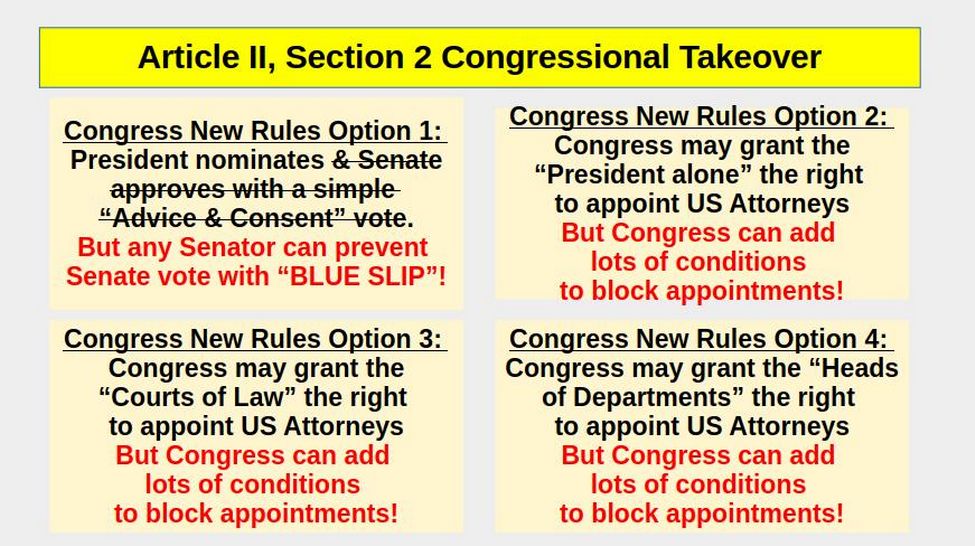
We will next cover current litigation on these three unconstitutional laws. However, there is only one possible solution to end the current gridlock and restore US Attorneys to every federal district – that is to ask the US Supreme Court to declare Section 541, Section 546 and the NVRA to be unconstitutional to the extent that they violate Article II, section 2, clause 2 and to the extend that they obstruct the appointment of US Attorneys. In addition, the US Supreme Court must declare the Senate Blue Slip Policy to be unconstitutional to the extent that it obstructs the Advice and Consent process by prohibiting a vote on Presidential nominees for US Attorneys.
Section 5 Summary of current litigation on Senate obstruction of US Attorney appointments
Since a few US Senators have used the Blue Slip policy to block the Senate from its “advice and consent” duty, several states in addition to Washington currently do not have a clearly US Attorney. The Trump administration has attempted to appoint “acting” US Attorneys and “special” US Attorneys (as we describe in Section 4). However, many of these have been challenged in federal courts. We will here cover the current litigation on some of these cases in order to demonstrate that the failure to declare Section 546 to be unconstitutional merely results in ongoing gridlock – depriving millions of Americans to have a valid US Attorney in their district.
United States v. Salazar Del Real, District Court, D. Nevada The case file for this case is at the following link: https://www.courtlistener.com/docket/70952148/united-states-v-salazar-del-real/
This case is a dispute between the US Department of Justice which claims that their “acting” US Attorney (Ms. Chattah) is a valid US Attorney for Nevada versus several Defendants who claim that Ms. Chattah is not a valid US Attorney because she has exceeded the 120 day limit.
On September 10, 2025, the US DOJ filed a 28 page brief explaining why Ms. Chattah is a valid US Attorney for Nevada. Here are quotes from their brief:
“Ms. Chattah is validly serving as the Acting United States Attorney under the Federal Vacancies Reform Act (“FVRA”), 5 U.S.C. § 3345 et seq. The Attorney General reclassified the prior First Assistant United States Attorney as Executive United States Attorney, which the Attorney General could do under 28 U.S.C. § 542(b). Once (a) Ms. Chattah resigned as interim United States Attorney, and (b) the Attorney General appointed her as Special Attorney and designated her as First Assistant United States Attorney (exercising authority under §§ 509, 510, and 515), Ms. Chattah automatically became the Acting United States Attorney under 5 U.S.C. § 3345(a)(1).”
“At minimum, the Attorney General validly appointed Ms. Chattah as a Special Attorney under 28 U.S.C. § 515 and directed her to supervise the United States Attorney’s Office for the District of Nevada (“USAO-NV”). Whether or not Ms. Chattah technically qualifies as Acting United States Attorney, the Attorney General has validly delegated to her the authority to supervise all pending prosecutions and other matters in the USAO-NV, subject in turn to the supervision by the Attorney General and Deputy Attorney General, both of whom are Senate-confirmed.”
“On March 28, the Attorney General appointed Ms. Chattah as United States Attorney pursuant to 28 U.S.C. § 546, effective April 1. Pursuant to that statute, Ms. Chattah was authorized to serve as United States Attorney on an interim basis for 120 days. See 28 U.S.C. § 546(c)(2).”
“On July 28—119 days into Ms. Chattah’s term as United States Attorney—Ms. Chattah resigned from that position. See Exhibit 2. The same day, the Attorney General appointed Ms. Chattah as a Special Attorney under authority including 28 U.S.C. § 509, 510, and 515; designated her First Assistant United States Attorney “effective upon her resignation” as United States Attorney; and noted that as First Assistant United States Attorney, Ms. Chattah “will have the authority to serve as Acting United States Attorney upon a vacancy in the office subject to the conditions and time limitations of the Federal Vacancies Reform Act of 1998, 5 U.S.C. §§ 3345-3349(d).”
“The President has not nominated Ms. Chattah, nor anyone else, to serve as United States Attorney under 28 U.S.C. § 541(a), and the district court has not appointed Ms. Chattah, nor anyone else, to serve as United States Attorney for the District of Nevada under 28 U.S.C. § 546(d). Accordingly, Ms. Chattah continues to serve as Acting United States Attorney under the default provision of the FVRA, 5 U.S.C. § 3345(a)(1).”
“Although 28 U.S.C. § 547(1) authorizes the United States Attorney to “prosecute for all offenses against the United States” in her district, the authority to do so is not exclusive. All the functions of the United States Attorney, including the power to prosecute, are also vested in the Attorney General, 28 U.S.C. § 509, and the Attorney General has the power to supervise and direct United States Attorneys and Assistant United States Attorneys in the discharge of their duties, 28 U.S.C. §§ 510, 515, 519. In particular, the Attorney General may “specifically direct” any Department of Justice officer or other “attorney specially appointed” by her to “conduct any kind of legal proceeding … which United States attorneys are authorized by law to conduct….” 28 U.S.C. § 515(a). Accordingly, even if Ms. Chattah were not validly serving as the acting U.S. Attorney, she would be fully authorized, by delegation, to supervise criminal prosecutions in Nevada.
“Ms. Chattah is authorized to supervise this case because the Attorney General validly appointed her as a Special Attorney under 28 U.S.C. §§ 509, 510, and 515 and delegated her the authority to supervise all pending prosecutions.”
“Finally, the defendants argue that this Court should appoint another interim United States Attorney under 28 U.S.C. § 546(d). (But) Ms. Chattah resigned her interim position as United States Attorney before her 120-day term expired. Accordingly, the district court has no authority to appoint an interim United States Attorney.”
Nevada District Court September 30, 2025 Order
Unfortunately, the District Court judge disagreed with the US Department of Justice. On September 30, 2025, the Court issued a 32 page order. Here are quotes from this order:
“On March 28, 2025, the Attorney General of the United States, Pam Bondi, appointed Sigal Chattah to be the interim U.S. Attorney under 28 U.S.C. § 546(a). Ms. Chattah’s appointment was made effective April 1, 2025, and § 546(c)(2) limited her service to 120 days. If a permanent U.S. Attorney was not nominated by the President and confirmed by the Senate within that 120-day period, the statute provided that the judges of the Nevada District Court could appoint an interim U.S. Attorney to serve until the vacancy is filled by the President and Senate. 28 U.S.C. § 546(c)(2)-(d). That procedure was not followed.”
“The Nevada District Court Judges recused from hearing these motions to dismiss, presumably because the motions implicate their own power to appoint an Acting U.S. Attorney. See 28 U.S.C. § 546(d). “
“Defendants’ motions involve three sets of statutes:
(1) the Federal Vacancies Reform Act of 1998, 5 U.S.C. §§ 3345-3349 (“FVRA”), (2) 28 U.S.C. § 546, which is a separate statute that addresses appointments of interim U.S. Attorneys, and (3) 28 U.S.C. §§ 509, 510, and 515, which are general delegation statutes that authorize the Attorney General to share her power with lower level attorneys.”
“The FVRA is a general statutory scheme passed by Congress to regulate the temporary filling of vacant Executive Branch positions that require presidential appointment and Senate confirmation (commonly called “PAS” positions)… A person who temporarily fills a PAS position under one of these FVRA provisions is referred to as an “acting officer… An acting officer may serve for 210-days “beginning on the date the vacancy occurs.” Id. § 3346(a)(1)”
“In addition to the general vacancy-filling provisions of the FVRA, Congress has enacted a specific statute for temporarily filling U.S. Attorney vacancies. Section 546 provides that the Attorney General can appoint a U.S. Attorney to serve until the earlier of a PAS appointment or the expiration of 120 days.”
“General Delegation Statutes — 28 U.S.C. §§ 509, 510, and 515”
“Several statutory provisions grant the Attorney General power to delegate authority to U.S. Attorneys, Assistant U.S. Attorneys, and other lawyers working in the DOJ… Section 509 begins by providing that “all functions of other officers of the Department of Justice and all functions of agencies and employees of the Department of Justice are vested in the Attorney General,”
“Section 510 then provides that “the Attorney General may from time to time make such provisions as [she] considers appropriate authorizing the performance by any other officer, employee, or agency of the Department of Justice of any function of the Attorney General.” Id. § 510. And § 515 provides that “the Attorney General or any other officer of the Department of Justice, or any attorney specially appointed by the Attorney General under law, may, when specifically directed by the Attorney General, conduct any kind of legal proceeding, civil or criminal[.]” Id. § 515.If Ms. Chattah is not serving validly under the FVRA, the government contends she can continue supervising prosecutions in Nevada using authority delegated under these statutes.”
“After considering the “high bar” established by subsections (a)(2) and (a)(3) for presidential appointment of acting officials, the court in Giraud observed that “if the President may simply name anyone as the first assistant at any time and thereby vest them with acting powers, [the subsection (a)(2) and
(a)(3)] limitations on acting service are rendered entirely irrelevant.” 2025 WL 2416737, at *15. The President would be “free to select someone from outside the Government, with no experience in the relevant agency, and immediately imbue them with the functions and duties of a PAS office.”
(Note: a PAS office is an office subject to the Advice and Consent process).
“The government argues that the language of subsection (a)(1) is present-tense, meaning that it can operate at any time during a vacancy, and that a vacancy clearly existed when Ms. Chattah became first assistant.6 “Accordingly,” the government argues, “whoever is the first assistant to a vacant office, at any time during the period of the vacancy, automatically becomes the acting officer… The Court is not persuaded. “
On page 15, the order states:
“By choosing to make subsection (a)(1) an automatic default mechanism for filling vacancies temporarily, Congress exerted its constitutional power to specify how non-principal officers in the Executive Branch could be appointed. And by placing significant restrictions on the President’s power to fill those vacancies under subsections (a)(2) and (a)(3), Congress largely controlled who could be appointed.”
“To reinforce its choices, Congress made the FVRA “the exclusive means for temporarily authorizing an acting official to perform the functions and duties” of a PAS office, unless Congress itself has created another agency-specific statute. 5 U.S.C. § 3347(a). The FVRA also makes clear that general delegation powers cannot be used to fill vacancies. Id. § 3347(b). And it provides that the acts of persons serving in violation of the FVRA are void. Id. § 3348(d).”
All of the above is true. But all of the above clearly exceeds the authority given to Congress by Article II, Section 2 Clause 2 and therefore the NVRA is an unconstitutional abuse of Congressional power – at least to the extent that it fails to comply with the framework of Article II regarding the appointment of US Attorneys.
On page 25, the Nevada District Court Order states:
“Some may ask what happens if Ms. Chattah cannot serve under the FVRA. There are several possibilities. The President (and only the President) could appoint a temporary Acting U.S. Attorney who satisfies the strict requirements of § 3345(a)(2) or (a)(3). The judges of the District of Nevada could choose to exercise their power under 28 U.S.C. § 546(d) and appoint an Acting U.S. Attorney until the position is filled. Or the President could nominate a U.S. Attorney and seek quick confirmation by the Senate.”
As noted earlier, the first two options are not among the options in Article II, Section 2, Clause 2 and are therefore unconstitutional. The third option ignores the Blue Slip policy in the US Senate being used to obstruct any Trump nominees from being considered by the Senate Advice and Consent process. Therefore, the only Constitutionally valid option is for the Department of Justice to go directly to the US Supreme Court and ask them to enforce Article II, Section 2, Clause 2 of the US Constitution.
Nevada Court October 23 2025 Order staying the September 30 Order
The Department of Justice appealed the Nevada District Court September 30, 2025 Order and asked that the Order be stayed pending appeal. On October 23 2025 the Nevada District Court stayed the September 30, 2025 Order. Here is a link to the October 23, 2025 Order
https://storage.courtlistener.com/recap/gov.uscourts.nvd.176025/gov.uscourts.nvd.176025.57.0.pdf
Here are quotes from this order:
“To justify a stay, a moving party must at least show that “serious legal questions are raised” by the appeal… The Court recognizes that the disqualification motions raise novel and important issues. Only one other court has addressed these issues. See United States v. Giraud, --- F.Supp.3d ----, 2025 WL 2416737 (D.N.J. Aug. 21, 2025). They present important questions of when and how the President or Attorney General can fill a vacancy in a U.S. Attorney position on an acting basis. These issues are sufficiently serious to satisfy the first stay requirement.”
“The potential harm arises from the Constitution’s division of federal powers and the deference and respect each of the three federal branches should afford each other. The concern, as the Ninth Circuit has noted, is “harm to the separation of powers.” United States v. Williams, 68 F.4th 564, 570 (9th Cir. 2023). Such harm is particularly relevant in this case because “the doctrine of separation of powers requires judicial respect for the independence of the prosecutor.”
This case is currently set for trial later in 2026. Regardless of the outcome of that trial, the loser will appeal the decision to the US Supreme Court. It will therefore likely take years to resolve. During this time, citizens in Washington State will be left with a possibly invalid US Attorney. Such a delay is therefore not acceptable.
New Jersey District Court United States v. Giraud
The other case with a developed public record is United States v. Giraud. Here is a link to the case filings:
https://www.courtlistener.com/docket/69409921/united-states-v-giraud-iii/
The US Department of Justice filed a 29 page Brief on July 29, 2025 which can be downloaded at this link:
https://storage.courtlistener.com/recap/gov.uscourts.njd.557842/gov.uscourts.njd.557842.108.0.pdf
Here are quotes from this brief:
“Ms. Habba is validly serving as the Acting United States Attorney. The Attorney General properly appointed her as the First Assistant United States Attorney; the First Assistant can serve as the Acting United States Attorney under the Federal Vacancies Reform Act when that office is vacant; and the President properly removed as United States Attorney an individual whom the District Court for the District of New Jersey purported to appoint.”
“At minimum, Ms. Habba has been properly appointed as a Special Attorney to the Attorney General of the United States and directed to supervise the USAO-NJ. Pursuant to that appointment alone, she could still supervise this case—which was initiated by a validly empaneled grand jury and a Senate-confirmed U.S. Attorney—and the Assistant U.S. Attorneys assigned to it can continue prosecuting it under their own delegated authority from the Attorney General, subject to supervision by both Ms. Habba and Senate-confirmed officials in Main Justice, including the Attorney General and the Deputy Attorney General.”
“The President had nominated Ms. Habba as United States Attorney on June 30, 2025. The President withdrew that nomination last Thursday, July 24. Id. The Senate had never acted on it, much less rejected it.”
“The same day, Ms. Habba resigned her interim position as United States Attorney. Exhibit D. The Attorney General then appointed her as a Special Attorney under 28 U.S.C. § 515, which appointment Ms. Habba accepted.”
“Exercising her authority under 28 U.S.C. §§ 509, 510, 515 and 542, among other provisions, the Attorney General also designated Ms. Habba as First Assistant, effective upon her resignation as United States Attorney. Exhibit G. All of this occurred on Thursday, July 24, before the 120-day limit period in § 546(c)(2) expired.”
“Ms. Habba is validly serving as the Acting United States Attorney under the Federal Vacancies Reform Act (FVRA), 5 U.S.C. § 3345.”
“The real separation of powers violation in this case would be to force the President and Attorney General to permit a judicially appointed United States Attorney to remain in office despite their stated preference for someone else to lead that office.”
“At minimum, the Attorney General validly appointed Ms. Habba as a Special Attorney under 28 U.S.C. § 515 and directed her to supervise the USAO-NJ. “
On August 1, 2025, the District Court issued a 27 page Opinion which can be read at this link: https://storage.courtlistener.com/recap/gov.uscourts.njd.557842/gov.uscourts.njd.557842.116.0.pdf
Here are quotes from this opinion:
“On June 30, 2025, with about one month remaining in her interim appointment, President Trump formally nominated Ms. Habba to be the United States Attorney. But the Senate did not act, and the 120-day deadline grew nearer.”
“On July 22, 2025—120 days from March 24, 2025, when President Trump posted that Ms. Habba had been appointed “effective immediately”—the Judges of the United States District Court for the District of New Jersey invoked their statutory power to appoint a United States Attorney upon the expiration of an Interim United States Attorney’s 120-day term pursuant to section 546(d).”
“Trump Administration officials, knowing that Ms. Habba’s term did not end until midnight on Friday, July 25, 2025, conceived a multi-step maneuver to keep her in the United States Attorney role.”
“Ms. Habba’s name has appeared on the signature block of each of the Government’s briefs in this case bearing the title “Acting United States Attorney.”81 Assuming that Ms. Habba is legally barred from holding that office, as I am for the purposes of this opinion, such involvement would be illegal and subject to invalidation under the Appointments Clause or statute.”
On August 12, 2025, the Department of Justice filed a 34 page brief in opposition which can be read at this link:
https://storage.courtlistener.com/recap/gov.uscourts.njd.557842/gov.uscourts.njd.557842.127.0.pdf
Here are quotes from this brief:
“The office of U.S. Attorney is indisputably vacant, as Ms. Habba resigned as interim U.S. Attorney on July 24 and the President on July 26 removed the individual whom the District Court had purported to appoint as her successor. The Attorney General properly appointed Ms. Habba Special Attorney and designated her as the First Assistant U.S. Attorney (FAUSA or First Assistant), and as the First Assistant, she can serve as the Acting U.S. Attorney under the Federal Vacancies Reform Act (FVRA). Ms. Habba’s role as Acting U.S. Attorney contravenes neither the FVRA nor 28 U.S.C. § 546(d).”
On August 21, 2025, the court issued a 77 page Opinion which can be read at this link.
Here are quotes from this opinion:
The Executive branch has perpetuated Alina Habba’s appointment to act as the United States Attorney for the District of New Jersey through a novel series of legal and personnel moves. Along the way, it has disagreed with the Judges of the United States District Court for the District of New Jersey and criminal defendants in that District about who should or may lead the office. Faced with the question of whether Ms. Habba is lawfully performing the functions and duties of the office of the United States Attorney for the District of New Jersey, I conclude that she is not.
“Undeterred, the Government responds that she may still perform the functions and duties of the office of the United States Attorney through her appointment as a Special Attorney vested with the powers of a United States Attorney pursuant to statutes generally vesting all of the duties of the Department of Justice in the Attorney General and granting the Attorney General power to delegate all of her duties. I proceed by (1) describing the contours of this theory, and then explain why I conclude that it is not viable because: (2) the scope of the delegation is commensurate with the powers of a PAS United States Attorney; (3) the Government’s maneuver is prohibited by the FVRA’s exclusivity provision, 5 U.S.C. § 3347(b).”
Third Circuit Opinion
On August 25, 2025, the Department of Justice appealed. The Third Circuit issued a 1 page decision on December 1, 2025 affirming the Trial Court. They also issued a 32 page Opinion which can be read at this link.
Here are quotes from this Opinion:
“The United States Attorneys’ offices are some of the most critical agencies in the Federal Government. They play an important role in the criminal and civil justice systems and are vital in keeping our communities safe. the citizens of New Jersey and the loyal employees in the U.S. Attorney’s Office deserve some clarity and stability.”
“The Government argues that Habba is the Acting U.S. Attorney for New Jersey under the FVRA by virtue of her designation as First Assistant U.S. Attorney. In considering this claim, we must decide: (1) whether only the first assistant in place at the time of a PAS officer’s resignation automatically assumes acting officer duties under § 3345(a)(1); and (2) whether the nomination bar in § 3345(b)(1) prevents a person from assuming acting officer duties even if her nomination is no longer pending before the Senate. We answer both questions in the affirmative.”
“The Government contends that, even if Habba is not the Acting U.S. Attorney under the FVRA, she nonetheless “may continue to exercise prosecutorial and supervisory authority. . . pursuant to the Attorney General’s express delegation of authority to her in her capacity as Special Attorney and First Assistant U.S. Attorney.”. This broad delegation is directly contrary to the exclusivity provision of the FVRA.”
“The FVRA is “the exclusive means for temporarily authorizing an acting official to perform the functions and duties of any [PAS] office,” 5 U.S.C. § 3347(a), unless a statute expressly authorizes another means of acting or interim service in a specified office, id. § 3347(a)(1.”
The New Jersey Third Circuit case has not yet been appealed to the US Supreme Court.
UNITED STATES OF AMERICA v. LETITIA JAMES, Eastern District of Virginia
The meaning of Article 2, Section 2, Clause 2 is also being litigated in two cases in the Fourth Circuit. The case file for the first cases is at this link: https://www.courtlistener.com/docket/71601414/united-states-v-james/
On November 24, 2025, the District Court issued a 26 page order which can be read at this link: https://storage.courtlistener.com/recap/gov.uscourts.vaed.583342/gov.uscourts.vaed.583342.140.0_3.pdf
Here is a quote from this Opinion: Ms. James now moves to dismiss the indictment on the ground that Ms. Halligan, the sole prosecutor who presented the case to the grand jury, was unlawfully appointed in violation of 28 U.S.C. § 546 and the Constitution’s Appointments Clause. As explained below, I agree with Ms. James that the Attorney General’s attempt to install Ms. Halligan as Interim U.S. Attorney for the Eastern District of Virginia was invalid. And because Ms. Halligan had no lawful authority to present the indictment, I will grant Ms. James’s motion and dismiss the indictment without prejudice.
On December 19, 2025, this ruling was appealed by the DOJ to the Fourth Circuit.
UNITED STATES OF AMERICA v. JAMES COMEY, Eastern District of Virginia
Also in Virginia federal court, on November 24, 2025 a judge issued a 29 page opinion dismissing a criminal case against former FBI Director James Comey on the grounds that the interim U.S. attorney who filed the charges, Lindsey Halligan, was unlawfully appointed. Here is a link to the Comey Dismissal Order: https://storage.courtlistener.com/recap/gov.uscourts.vaed.582136/gov.uscourts.vaed.582136.213.0_1.pdf
Here are quotes from this Opinion:
“Mr. Comey now moves to dismiss the indictment on the ground that Ms. Halligan, the sole prosecutor who presented the case to the grand jury, was unlawfully appointed in violation of 28 U.S.C. § 546 and the Constitution’s Appointments Clause. As explained below, I agree with Mr. Comey that the Attorney General’s attempt to install Ms. Halligan as Interim U.S. Attorney for the Eastern District of Virginia was invalid. And because Ms. Halligan had no lawful authority to present the indictment, I will grant Mr. Comey’s motion and dismiss the indictment without prejudice.”
“Congress has established a mechanism, set forth in 28 U.S.C. § 546, for appointing interim U.S. Attorneys when a vacancy arises.2 Section 546 essentially “divide[s] the responsibility for making interim appointments between the Attorney General and the district courts.”
“On September 22, 2025, the Attorney General issued an order “authorizing Lindsey Halligan to be the Interim United States Attorney for the Eastern District of Virginia during the vacancy in that office” (“September 22 Order”). Att’y Gen. Order No. 6402-2025. The September 22 Order cites only 28 U.S.C. § 546 as the basis for Ms. Halligan’s appointment.”
“According to the Government, this case is “simple.” In its view, the “one and only” limitation on the Attorney General’s authority to appoint interim U.S. Attorneys under section 546 is subsection (b), which bars the Attorney General from appointing anyone whom the Senate has refused to confirm. “Nothing in the text,” it continues, “explicitly or implicitly” precludes the Attorney General from making multiple interim appointments during a vacancy. Id. at 8. Thus, it concludes, because “the Senate has not refused advice and consent to Ms. Halligan,” the Attorney General “lawfully appointed her as interim U.S. Attorney” on September 22. “
“The text and structure of section 546(d) in particular make clear the appointment power (1) shifts to the district court after the 120-day period and (2) does not revert to the Attorney General if a court-appointed U.S. Attorney leaves office before a Senate-confirmed U.S. Attorney is installed.”
“This reading is reinforced by the negative-implication canon, which recognizes that the “expression of one thing implies the exclusion of others.” Antonin Scalia & Bryan A. Garner, Reading Law: The Interpretation of Legal Texts 107 (2012). To be sure, the Supreme Court has cautioned that the “force of any negative implication . . . depends on context,” and that the “canon applies only when circumstances support a sensible inference that the term left out must have been meant to be excluded,” NLRB v. SW Gen., Inc., 580 U.S. 288, 302 (2017).”
“In sum, the text, structure, and history of section 546 point to one conclusion: the Attorney General’s authority to appoint an interim U.S. Attorney lasts for a total of 120 days from the date she first invokes section 546 after the departure of a Senate-confirmed U.S. Attorney. If the position remains vacant at the end of the 120-day period, the exclusive authority to make further interim appointments shifts to the district court, where it remains until the President’s nominee is confirmed by the Senate.”
January 6 2026 United States of America v Davante Jefferson
Also in the Virginia federal court, in a separate case, a different federal judge issued a 3 page order asking Lindsey Halligan to explain why she continues to call herself the U.S. attorney for the Eastern District of Virginia and is still serving in that position even though another judge determined in November that she had been unlawfully appointed to the position. Here is a link to this Order: https://storage.courtlistener.com/recap/gov.uscourts.vaed.586310/gov.uscourts.vaed.586310.16.0.pdf
Novak gave Halligan seven days to respond in writing “explaining the basis for ... identification of herself as the United States Attorney, notwithstanding Judge Currie’s contrary ruling. She shall also set forth the reasons why this Court should not strike Ms. Halligan’s identification of herself as United States Attorney from the indictment in this matter.”
The judge’s order goes on to say Halligan "shall further explain why her identification does not constitute a false or misleading statement."
While the November ruling regarding Halligan’s appointment had been appealed the judge noted that since the order had not been paused, it remains “binding precedent of the district and is not subject to being ignored.”
On January 13, 2026, the DOJ filed an 11 page response to the January 6, 2026 court order which can be read at this link:
https://storage.courtlistener.com/recap/gov.uscourts.vaed.586311/gov.uscourts.vaed.586311.22.0.pdf
Here are quotes from this response:
“The order launching this quest reflects a fundamental misunderstanding of Judge Currie’s orders dismissing the indictments in United States v. Comey, No. 1:25-cr-272 and United States v. James, 2:25-cr-122 and flouts no fewer than three separate lines of Supreme Court precedent on elementary principles like the role of federal courts, the effect of district court rulings, and the nature of our adversarial system.”
“Adding insult to error, the order posits that the United States’ continued assertion of its legal position that Ms. Halligan properly serves as the United States Attorney amounts to a factual misrepresentation that could trigger attorney discipline. The Court’s thinly veiled threat to use attorney discipline to cudgel the Executive Branch into conforming its legal position in all criminal prosecutions to the views of a single district judge is a gross abuse of power and an affront to the separation of powers. “
“The dismissal orders in Comey and James do not prohibit, or render factually false, the United States’ continued representation of its legal position that Ms. Halligan is the United States Attorney.”
“Although Judge Currie concluded that Ms. Halligan was unlawfully appointed under Section 546, she did not purport to enjoin Ms. Halligan from continuing to oversee the office or from identifying herself as the United States Attorney in the Government’s signature blocks. Indeed, Judge Currie did not issue any remedy beyond those two cases—she simply dismissed the indictments without prejudice.”
“Judge Currie stated that “the appointment of Ms. Halligan as Interim U.S. Attorney violated 28 U.S.C. § 546 and the Appointments Clause of the U.S. Constitution.”
“But that is simply a statement of her basis for ordering dismissal of the indictment, not an independent declaratory judgment. A declaratory judgment is a remedy that operates as “a final judgment” entered at the conclusion of a case initiated by “an appropriate pleading,” not an interlocutory order on a motion in a criminal case.”
“But even if Judge Currie had somehow issued a declaratory judgment – which she did not – such relief would still not bind the United States in other cases or prevent Ms. Halligan from otherwise holding herself out as the United States Attorney. A declaratory judgment does not “order[] that anything be done” or “seek execution of performance.”
“The Supreme Court flatly rejected the idea, apparently still championed by this Court, that “once a single district court deems executive conduct unlawful, it has stated what the law requires, and the Executive must conform to that view... The United States is not required to treat her reasoning as law in any other case.”
“On July 15, 2024, Judge Cannon dismissed United States v. Trump on Appointments Clause grounds, concluding that Jack Smith was not properly appointed as a “Special Counsel.” See Order, United States v. Trump, No, 23-80101-CR-Cannon, ECF No. 672 (S.D. Fla. July 15, 2024). Yet in the days and weeks that followed, the Government continued – openly and without objection by any Court – to file documents identifying Jack Smith by his title as Special Counsel while appellate review proceeded.”
It is the United States’ position that Ms. Halligan was properly appointed as interim United States Attorney—a position the United States has maintained in part based on internal legal advice from the Department of Justice’s Office of Legal Counsel. That Judge Currie dismissed two indictments based on her disagreement with that position does not prevent the United States from otherwise maintaining it.
To answer the Court’s inquisition directly: “the basis for Ms. Halligan’s identification of herself as the United States Attorney, notwithstanding Judge Currie’s contrary ruling” is that, in the Government’s view, Ms. Halligan is the United States Attorney, and Judge Currie’s ruling did not and could not require the United States to acquiesce to her contrary (and erroneous) legal reasoning outside of those cases. “
On January 20, 2026, the Court issued another 18 page Order which can be read at this link:
https://storage.courtlistener.com/recap/gov.uscourts.vaed.586311/gov.uscourts.vaed.586311.23.0.pdf
Here are quotes from this order:
Ultimately, the Court concludes for the reasons that follow that Ms. Halligan’s continued identification of herself as the United States Attorney for this District ignores a binding court order and may not continue; otherwise, Ms. Halligan and anyone who joins her on a pleading containing the improper moniker subjects themselves to potential disciplinary action in this Court pursuant to the Court’s Local Rules.
Judge Currie held that Ms. Halligan’s appointment as Interim U.S. Attorney for the Eastern District of Virginia was invalid and that Ms. Halligan has been unlawfully serving in that role since September 22, 2025.”
As of this writing, the Department of Justice has not sought a stay of Judge Currie’s rulings from her, the presiding judge in either case, or the Fourth Circuit.
Notably, even if Ms. Halligan was validly appointed by Attorney General Bondi on September 22, 2025, that appointment would expire today, January 20, 2026.
“Ms. Halligan has not only ignored Judge Currie’s rulings, she has also turned a blind eye to an Order from the Chief Judge of the Fourth Circuit. The Court finds it inconceivable that the Department of Justice, which holds a duty to faithfully execute the laws of the United States even those with which it may have disagreement would repeatedly ignore court orders, while simultaneously prosecuting citizens for breaking the law.
Ms. Halligan’s arguments based on the Supreme Court’s recent decision in Trump v. CASA, Inc. are similarly inapposite. Ms. Halligan quotes CASA for the proposition that “‘neither declaratory nor injunctive relief applies beyond the parties.” (Response at 3 (quoting CASA, 606 U.S. at 844).) But that statement concerned the “enforcement of contested statutes or ordinances,” neither of which stands at issue here. CASA, 606 U.S. at 844.
More importantly. CASA addressed the specific question of the legality of nationwide or universal injunctions “whether Congress has granted federal courts the authority to universally enjoin the enforcement of an executive or legislative policy' which the Court correctly termed an “expansive remedy.” Id. at 839-40. No such injunction was ordered here.
“Judge Currie, speaking for all district judges in this District, found Ms. Halligan’s appointment as Interim United States Attorney unlawful and issued two orders dismissing indictments, both of which were premised directly on that rationale. Those Orders, though currently on appeal, have not been overturned or stayed, and thus constitute the law of this District. Having been found by this Court to be unlawfully appointed, Ms. Halligan lacks lawful authority to represent herself as the United States Attorney before this Court.”
Ms. Halligan’s insistence on including “United States Attorney” in her signature block exhibits disrespect not just for this Court, but also flaunts the Rule of Law more broadly. It also self-evidently manifests noncompliance with Judge Currie’s Orders.
Ms. Halligan’s Response asserts that she is free to act in an unlawful capacity, because she disagrees that she does so unlawfully. But that’s not how our legal system works. By having continued to exercise a position to which she was unconstitutionally appointed, including by signing the indictment in this case as "United States Attorney,” Ms. Halligan exercised “power that [she] did not lawfully possess. Collins V. Yellen, 594 U.S. 220, 258 (2021). In the words of Justice Gorsuch, since Ms. Halligan was “unconstitutionally installed,” she “cannot wield executive power except as Article II provides. Attempts to do so are void.
For all of these reasons, the Court hereby STRIKES the words “United States Attorney' from the signature block on the Indictment (ECF No. 1), as well as all other Government filings in this case. (ECF Nos. 13, 18, 22.) The Court further BARS Ms. Halligan from representing herself as the United States Attorney in any pleading or otherwise before this Court until such time as she may lawfully hold the office either by Senate confirmation or appointment by this Court pursuant to 28 U.S.C. § 546(d), should either occur. That bar shall become effective at 12:01 a.m. on January 21,2026, and shall apply to any filings submitted thereafter.
New York Northern District Litigation
On January 8, 2026, a New York federal judge disqualified a DOJ appointed federal prosecutor in investigation into New York Attorney General Letitia James. U.S. District Judge Lorna G. Schofield blocked subpoenas requested by John Sarcone, the acting U.S. attorney for the Northern District of New York. The judge said the Department of Justice did not follow statutory procedure after New York judges declined to extend Sarcone’s tenure in 2025. Here is a link to this 24 page Opinion:
https://storage.courtlistener.com/recap/gov.uscourts.nynd.149556/gov.uscourts.nynd.149556.50.0.pdf
Here is a quote from this opinion:
“Mr. Sarcone’s service was and is unlawful because it bypassed the statutory requirements that govern who may exercise the powers of a U.S. Attorney. U.S. Attorneys must be nominated by the President and confirmed by the Senate. When a vacancy arises, federal law provides limited alternatives to fill the position temporarily. None authorized Mr. Sarcone to serve as Acting U.S. Attorney.”
October 28, 2025 California Central District Order
On October 28, 2025, a California federal district judge in the Ninth Circuit issued a 64 page Order disqualified the acting U.S. attorney Southern California Bill Essayli, saying he had stayed in the temporary jobs longer than allowed by law. Here is a link to this case file: https://www.courtlistener.com/docket/71218463/united-states-v-ramirez/
Here is a link to the Order: https://storage.courtlistener.com/recap/gov.uscourts.cacd.983892/gov.uscourts.cacd.983892.56.0.pdf
Here are quotes from this Order:
“Bilal A. Essayli (“Essayli”) is not lawfully serving as Acting United States Attorney for the Central District of California. The Attorney General’s July 29, 2025 order did not function to put him in that role. And he has been unlawfully serving in that role since he resigned as Interim United States Attorney.”
“Defendants contend that Essayli is unlawfully serving as Acting United States Attorney based on the manner by which he assumed the duties of an office that, by statute, requires the permanent occupant to be appointed by the President, by and with the advice and consent of the United States Senate. “
“FVRA Section 3345(a) is triggered only by the death, resignation, or incapacity of a PAS officer, so Essayli’s service as Acting United States Attorney cannot be premised on his resignation from the interim role… Because Essayli was not a PAS officer when he resigned from the position of Interim United States Attorney, his resignation from that position could not and did not trigger § 3345(a).”
On December 5, 2025, a 15 page Reply brief was filed which can be read at this link.
Here are quotes from this brief:
“The Appointments Clause deserves at least that footnote. It is not, as suggested by the government’s effort to avoid a ruling, a “trifling technicality.” Trump v. United States (Trump S. Ct.), 603 U.S. 593, 650 (2024) (Thomas, J., concurring). It is a foundational imperative. Of the six federal judges to have considered these challenges, this Court stands alone in endorsing the continued supervisory service of an improperly appointed temporary U.S. Attorney.”
“On the merits, the government insists that the Appointments Clause is satisfied because the agency head appointed Mr. Essayli. But that skips the first step of the analysis: the agency head’s action must be authorized by statute in the first place. On that point, the government is circumspect. It never comes out and says directly which statute authorized Mr. Essayli’s appointment. Instead, it turns to hand-waving and implication, including its suggestion that the Attorney General’s appointment power arises from the general “statutory and regulatory structure” writ large. “
“That is the whole ballgame. The Appointment Clause requires confirmation unless Congress has passed a law saying otherwise. Congress has never done so with respect to the office and powers Mr. Essayli now claims.”
“The government embraced Mr. Essayli’s inferior-officer status at the start of this motion practice, but it now waffles. The most direct statement of the government’s position is that Mr. Essayli’s officer status is “not at all clear.”
“The Court should reject that tactic at the outset. The government should not be permitted to litigate this case initially on the premise that Mr. Essayli “is an inferior officer,” and now backtrack to contend that he may not be.”
“At any rate, the suggestion that Mr. Essayli might be a mere employee is absurd in context of the case law...Exercising all those powers, Mr. Essayli is at least an inferior officer. He is paid a salary to supervise all cases in the district on a day-to-day basis—whether there are five indictments or fifty—not a per-case fee for occasional duties.”
“First assistant” authority. One of the government’s points is so misleading it warrants separate discussion… He is wielding significant authority, but the whole point is that he lacks that authority: it was not validly conferred on him by Congress.”
“This is just another way for the government to cast the trick it has played in benign language: appoint an ineligible individual to a vacant office, give him a different title not set out in the statutes, and thereby avoid all statutory limits on the appointment… The Appointments Clause requires confirmation of inferior officers, unless Congress clearly provides otherwise by statute.”
“In response to the defense’s call to identify a statutory office authorizing Mr. Essayli’s service, the government repeatedly cites a regulation, see R.R. 4, 7 (citing 28 C.F.R. § 0.137(b)), and relies not on any one statute but on the general “statutory and regulatory structure” of the Department.”
“The government cites no authority for the proposition that the executive itself, through agency regulation, can create an office and except it from the Appointments Clause without congressional approval. That is not the law… As Judge Currie recently confirmed in finding an Appointments Clause violation in Virginia, “by Law” means “by statute.” United States v. Comey, (E.D. Va. Nov. 24, 2025).”
“There has certainly been no statement (clear or otherwise) by Congress that a “first assistant” office exists, nor any statement that such a first assistant can wield inferior-officer powers without satisfying the default confirmation requirement. Across several decades, the consistent message from Congress has been: if the executive wants to appoint someone to wield U.S. Attorney powers, it can! But it must do so through one of the many statutory paths Congress has created—not one the executive has devised for itself… The government similarly nowhere mentions Section 543, the statute authorizing the appointment of special attorneys.”
“At the end of the day, the government’s string-cite theory is just another way of saying that the executive has a blank check to appoint whomever it desires. And the government’s theory is limitless: any position at the Department of Justice could be replicated under a different name and be filled indefinitely with an illegible and nonconfirmed person.”
The above case is still ongoing.
Summary of Current Litigation… It is time to change course and go directly to the heart of the issue
There have been at least 8 cases in 7 federal courts that have reviewed the Department of Justice attempts to use a combination of Section 541, Section 546 and or FVRA Section 3345 or other federal laws to evade the Blue Slip obstruction of Article II, Section 11, Clause 2 in order to appoint Interim, Acting or Special US Attorneys. All of these attempts have been blocked in federal courts. While some of these cases are being appealed, the appeals will likely take years and are unlikely to result in valid, permanent US Attorneys – especially in States like Washington that have a Senator who has vowed to use the Blue Slip to block Trump nominees.
The good news is that a simple reading of Article II, Section 2, Clause 2 does not give a single Senator the right to block the “advice and consent” process. Nor does it give Congress the right to impose conditions such as Section 541, Section 546 and or FVRA Section 3345 on US Attorney appointments.
We therefore urge the Department of Justice to change course and seek a US Supreme Court ruling enforcing the plain meaning of Article II, Section 2, Clause 2 of the US Constitution. This will allow US Attorney nominees to be approved with a simple majority vote of the US Senate.
Section 6 Actions of the a few Senators using Blue Slips to block the appointment of US attorneys in 2025
As we have previously explained, it is required by law that each of the 93 federal districts have a valid US Attorney who the People can go to for redress of grievances due to violations of their inalienable civil rights.
The Senate Judiciary Committee Blue Slip policy started in 1917 as an informal courtesy to encourage the President to collaborate with home-state senators during the nomination process. The Senate Judiciary Committee Blue Slip policy not codified in the Senate Judiciary Committee’s rules and is instead a informal unwritten policy set by the Chairperson of the Senate Judiciary Committee.
Importantly, until recently, the Blue Slip was informational only and not used to veto or completely block the Senate vote on Presidential nominees for either judgeships or US attorneys (which merely serve 4 year terms and are typically replaced by new Presidents at the beginning of their term.) Historically, during the past 100 years, the Blue Slip policy was rarely used. US Attorneys were approved in mass by voice vote.
From 1917 to 1955, under five Democrat and six Republican chairmen, home-state Senators were given the opportunity to testify before the Judiciary Committee in a nominee’s confirmation hearing. A negative blue slip, however, “was not intended to prevent committee action.” (See Sollenberger, The History of the Blue Slip, pp. 9–10. See also Binder and Maltzman, Advice and Dissent, p. 50 (“Before 1956…negative blue slips were treated as advisory to the committee and the full chamber, rather than as a single-handed committee veto exercised by a home state senator.”).
In other words, the blue-slip courtesy highlighted the views of home-state Senators but did not obstruct the Senate Advice and Consent process.
Senator James Eastland (D–MS) chaired the Judiciary Committee from 1956 to 1978. Unlike his predecessors, he treated negative or withheld blue slips as “absolute vetoes by Senators. Senate Judiciary Chairman Ted Kennedy (D–MA) criticized the “one-member veto” (Sollenberger, The History of the Blue Slip, p. 11). So did Chairman Thurmond.
Chairman Joe Biden offered the clearest rejection of the blue-slip courtesy as a single-Senator veto. In a letter to President Ronald Reagan in June 1989, he stated that a negative blue slip is a “significant factor to be weighed by the committee…but it will not preclude consideration of that nominee unless the Administration has not consulted with both home state Senators prior to submitting the nomination to the Senate.”
Chairman Orrin Hatch (R–UT) wrote President Bill Clinton in February 1995 stating that he would follow the “policy as articulated and practiced by Senator Biden in 1989. He repeated this position in the spring of 2001, saying that a negative blue slip would not be an automatic single-Senator veto.”
Chairman Patrick Leahy (D–VT) changed the blue slip back into a single-Senator veto.
The Blue Slip Policy becomes unclear
In the past few years, the Blue Slip policy has become unclear. For example, On November 16, 2017, Senate Judiciary Committee Chairman Grassley said, “I will not allow the White House to just steamroll home State Senators, but, as I have said all along, I will not allow the blue-slip process to be abused.”
Grassley also stated that he would “honor the blue-slip process, but that there are always exceptions.”
This lack of clarity has resulted in the Blue Slip policy being morphed into a political tool of obstruction, used to arbitrarily block Presidential nominees. While historically only a tiny fraction of US attorneys were blocked with Blue Slips, in 2025, a few Democratic Senators are blocking the appointments of nearly all Trump US Attorney nominees.
The”threat” of a blue slip is now being used preemptively to block potential nominees before they are even publicly nominated and thereby robbing the public of transparency over how they are being weaponized.
This Blue Slip Obstruction has brought litigation on important federal civil rights questions to a standstill – rendering both the US Constitution and important federal laws as well as recent US Supreme Court decisions to be meaningless and unenforceable as there are currently no US attorneys to file complaints against law breakers in many states – including Washington state.
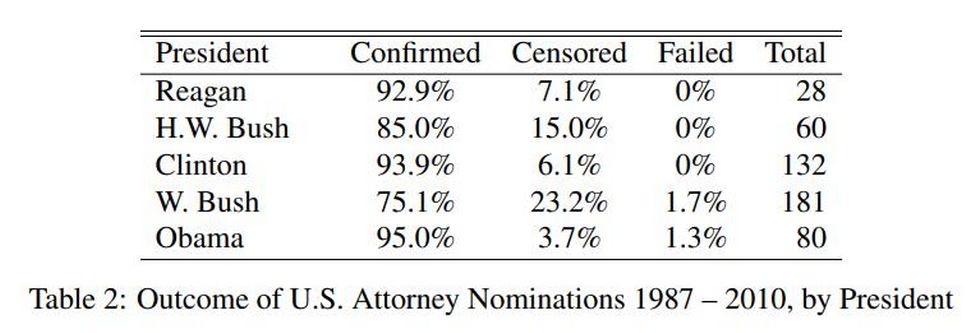
Between 1987 to 2010, about 90% of Presidential nominees were confirmed by the Senate:
Source: https://mjnelson.org/papers/Atty%20May13.pdf page 24.
During his first term, President Trump nominated 86 people to be US attorneys, and 84 of them were confirmed (97%).
President Biden nominated 76 people to be US attorneys: 68 of the nominations were confirmed by the US Senate (90%). 94 percent of US Attorneys during the Biden administration were confirmed by voice vote.
However, in 2025, 52% of US Attorneys in Republican states but, due to blue slip threats, only 10% of US Attorneys in states with a Democrat Senator were confirmed:
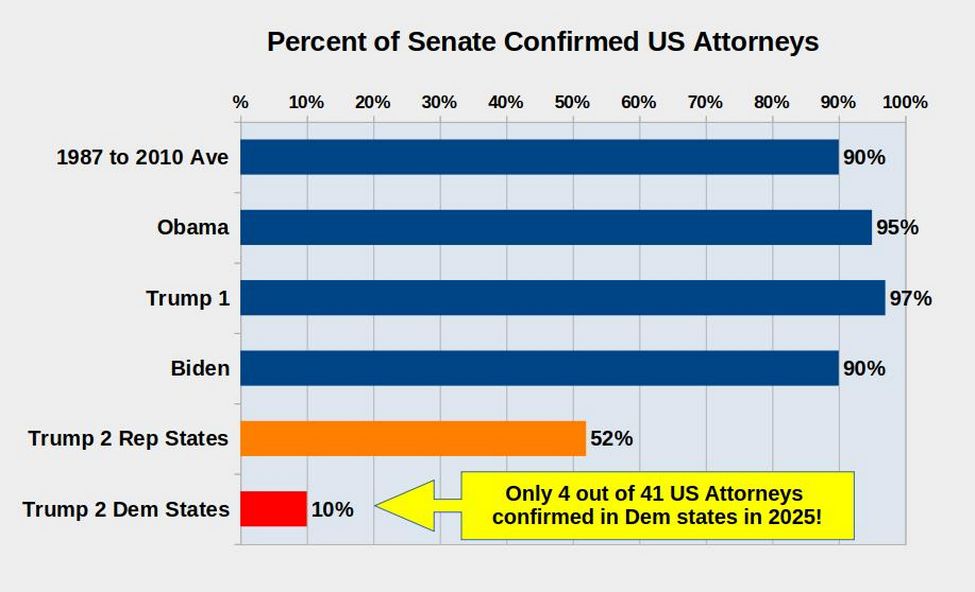
(See tables below for list of 2025 confirmed US Attorneys)
On November 15, 2017, Senate Judiciary Committee Chairman Chuck Grassley (R-Iowa) stated: “For the vast majority of the blue slip’s history, a negative or unreturned blue slip did not stop the Senate Judiciary Committee from holding a hearing and vote on a nominee. In fact, of my 18 predecessors as chairman of the committee, only two allowed home-state senators unilateral veto power through the blue slip. ... Consultation with the White House is something we senators should value and encourage. But we should not allow home-state senators to abuse this courtesy by attempting to block committee proceedings for political or ideological reasons. …”.
At the outset of the November 29, 2017, meeting of the Senate Judiciary Committee, the committee chairman, Sen. Chuck Grassley (R-Iowa), indicated that the blue slip policy would not be used as a means by which a home-state senator could prevent committee hearings. Grassley stated: "Home-state senators are entitled to lobby against confirmation, but they can't deny a nominee a hearing for political or ideological reasons. ... Some of my colleagues and outside groups have criticized me for allegedly abolishing a Senate tradition. As I've explained, that's not true. I'm restoring the traditional policy and practice of the vast majority of my predecessors over the past 100 years."
In 2025 a few Senators used Blue Slips to create a Constitutional Crisis
Sadly, in 2025, a few Senators elected to block the Senate Advice and Consent process using Blue Slips and the threat of Blue Slips. As the following Tables show, after nearly a year of the Trump Administration, only a small fraction of these 93 federal districts have valid US Attorneys. Many nominees have stalled, or not even been considered, because the home state senators have refused to return a “blue slip” for the nominee. The “blue slip” process allows home state senators to effectively veto the President’s nominees for positions in their state. If a senator refuses to return a blue slip for a nominee, the nomination will not even be considered. The practice started in the Senate over 100 years ago. But the Blue Slip policy has no basis in the US Constitution. The Senate’s role is advice and consent by a public vote of the full body.
On September 3, 2025, Senate Judiciary Chair Grassley claimed that Democrats are blocking all Trump US Attorney nominees:
“Communities around our country are in desperate need of U.S. Attorneys to protect the public and uphold the rule of law… You can’t prosecute the case if you don’t have the U.S. Attorney there to lead the effort and coordinate the effort with other branches of government.”
“Unfortunately, my Democratic colleagues have engaged in blanket obstruction of all nominees in their misguided attempt to derail the Trump Administration… This sweeping obstruction, shockingly, includes even highly qualified U.S. Attorneys that are supported by Democratic Senators. The actions of Senate Democrats are putting the American public in harm’s way… On May 22nd, the Ranking Member of the Judiciary Committee announced a hold on the nomination of the U.S. Attorney for the Southern District of Florida. Since then, the Senate Minority Leader and Senate Democrats have expanded the hold to apply to all 93 U.S. Attorneys. This blockade of public officials is unprecedented and untenable.”
Zero percent of U.S. Attorneys have been confirmed by voice vote so far during the second Trump administration.
As of September 2025, Trump had just two Senate-confirmed U.S. attorneys in place. As of January 2026, the US Senate had confirmed 31 US Attorneys (about 33%) but they were nearly all in Republican states. In states with a Democratic Senator, only 4 US Attorneys were confirmed out of 41 federal districts – (about 10%).
Thus, there was a dramatic increase in blocking the appointment of US Attorneys in 2025 – especially in states with a Democratic Party Senator. Senate Republicans overcame the partisan blockade in States with Republican Senators in October, confirming 18 U.S. Attorneys as part of the first nominations package of 107 executive nominees.
Below, we divide US Attorneys for all 93 districts into two groups. The current US Attorneys are as listed on the Department of Justice web page: https://www.justice.gov/usao/us-attorneys-listing
However, because most of these current US Attorneys have not been confirmed by the US State, they can not assumed to be valid US Attorneys.
The first Table includes States with one or more Democrat senators. These states had 4 confirmed US attorneys for 41 positions… Only about 10% have been confirmed by the Senate and 90% have not been confirmed by the Senate as of January 2026:
|
Party |
State - District |
Current US Attorney |
Confirmed by Senate |
|
B |
Maine |
Andrew Benson |
no |
|
B |
Pennsylvania East |
David Metcalf |
confirmed 10/07/25 |
|
B |
Pennsylvania Middle |
Brian D. Miller |
no |
|
B |
Pennsylvania West |
Troy Rivetti |
no |
|
B |
Wisconsin East |
Brad Schimel |
no |
|
B |
Wisconsin West |
Chadwick Elgersma |
no |
|
D |
Arizona |
Timothy Courchaine |
no |
|
D |
California Central |
Bilal Essayli |
no |
|
D |
California East |
Eric Grant |
no |
|
D |
California North |
Craig Missakian |
no |
|
D |
California South |
Adam Gordon |
no |
|
D |
Colorado |
Peter McNeilly |
no |
|
D |
Connecticut |
David Sullivan |
no |
|
D |
Delaware |
Benjamin Wallace |
no |
|
D |
Georgia Middle |
William Keyes |
no |
|
D |
Georgia North |
Theodore Hertzberg |
no |
|
D |
Georgia South |
Meg Heap |
no |
|
D |
Hawaii |
Ken Sorenson |
no |
|
D |
Illinois Central |
Gregory Gilmore |
no |
|
D |
Illinois North |
Andrew Boutros |
no |
|
D |
Illinois South |
Steven Weinhoeft |
no |
|
D |
Maryland |
Kelly Hayes |
no |
|
D |
Massachusetts |
Leah Foley |
no |
|
D |
Michigan East |
Jerome Gorgon |
confirmed 12/18/25 |
|
D |
Michigan West |
Timothy VerHey |
no |
|
D |
Minnesota |
Daniel Rosen |
confirmed 10/07/25 |
|
D |
Nevada |
Sigal Chattah |
no |
|
D |
New Hampshire |
Erin Creegan |
confirmed 12/18/25 |
|
D |
New Jersey |
None listed |
no |
|
D |
New Mexico |
Ryan Ellison |
no |
|
D |
New York East |
Joseph Nocella |
no |
|
D |
New York North |
John Sarcone |
no |
|
D |
New York South |
Jay Clayton |
no |
|
D |
New York West |
Michael DiGiacomo |
no |
|
D |
Oregon |
Scott Bradford |
no |
|
D |
Rhode Island |
Charles Calenda |
no |
|
D |
Vermont |
Michael P. Drescher |
no |
|
D |
Virginia East |
Lindsey Halligan |
no |
|
D |
Virginia West |
Robert Tracci |
no |
|
D |
Washington East |
Pete Serrano |
no |
|
D |
Washington West |
Charles Neil Floyd |
no |
States with two Republican Senators have 27 confirmed US Attorneys in 52 federal districts (52%).
|
Party |
State - District |
Current US Attorney |
Confirmed by the Senate |
|---|---|---|---|
|
R |
Alabama Middle |
Kevin Davidson |
no |
|
R |
Alabama North |
Prim Escalona |
no |
|
R |
Alabama South |
Sean Costello |
no |
|
R |
Alaska |
Michael Heyman |
no |
|
R |
Arkansas East |
Jonathan Ross |
no |
|
R |
Arkansas West |
David Fowlkes |
no |
|
R |
Florida Middle |
Gregory Kehoe |
no |
|
R |
Florida North |
John Heekin |
confirmed 10/07/25 |
|
R |
Florida South |
Jason Quiñones |
confirmed 08/02/25 |
|
R |
Idaho |
Bart Davis |
confirmed 10/07/25 |
|
R |
Indiana North |
Adam Mildred |
confirmed 12/18/25 |
|
R |
Indiana South |
Thomas Wheeler |
confirmed 12/18/25 |
|
R |
Iowa North |
Leif Olson |
confirmed 10/07/25 |
|
R |
Iowa South |
David Waterman |
confirmed 10/07/25 |
|
R |
Kansas |
Ryan Kriegshauser |
confirmed 12/18/25 |
|
R |
Kentucky East |
Paul McCaffrey |
no |
|
R |
Kentucky West |
Kyle Bumgarner |
no |
|
R |
Louisiana East |
David Courcelle |
confirmed 12/18/25 |
|
R |
Louisiana Middle |
Kurt Wall |
confirmed 10/07/25 |
|
R |
Louisiana West |
Zachary Keller |
no |
|
R |
Mississippi North |
Scott Leary |
confirmed 12/18/25 |
|
R |
Mississippi South |
James Kruger |
confirmed 12/18/25 |
|
R |
Missouri East |
Thomas Albus |
confirmed 12/18/25 |
|
R |
Missouri West |
Richard Price |
no |
|
R |
Montana |
Kurt Alme |
Confirmed 10/07/25 |
|
R |
Nebraska |
Lesley Murphy |
Confirmed 10/07/25 |
|
R |
North Carolina East |
Ellis Boyle |
no |
|
R |
North Carolina Middle |
Dan Bishop |
no |
|
R |
North Carolina West |
Thomas Ferguson |
confirmed 12/18/25 |
|
R |
North Dakota |
Nicholas W. Chase |
Confirmed 10/07/25 |
|
R |
Ohio North |
David Toepfer |
Confirmed 10/07/25 |
|
R |
Ohio South |
Dominick Gerace |
confirmed 12/18/25 |
|
R |
Oklahoma East |
Christopher Wilson |
no |
|
R |
Oklahoma North |
Clint Johnson |
no |
|
R |
Oklahoma West |
Robert Troester |
no |
|
R |
South Carolina |
Bryan Stirling |
confirmed 12/18/25 |
|
R |
South Dakota |
Ron Parsons |
confirmed 10/07/25 |
|
R |
Tennessee East |
Francis Hamilton III |
no |
|
R |
Tennessee Middle |
Braden Boucek |
confirmed 12/18/25 |
|
R |
Tennessee West |
D. Michael Dunavant |
confirmed 10/07/25 |
|
R |
Texas East |
Jay Combs |
no |
|
R |
Texas North |
Ryan Raybould |
no |
|
R |
Texas South |
Nicholas Ganjei |
no |
|
R |
Texas West |
Justin Simmons |
no |
|
R |
Utah |
Melissa Holyoak |
no |
|
R |
West Virginia North |
Matthew Harvey |
confirmed 10/07/25 |
|
R |
West Virginia South |
Moore Capito |
confirmed 10/07/25 |
|
R |
Wyoming |
Darin Smith |
no |
|
X |
District of Columbia |
Jeanine Pirro |
Confirmed 08/02/25 |
|
X |
Guam |
Shawn Anderson |
no |
|
X |
District of Puerto Rico |
Stephen Muldrow |
no |
|
X |
Virgin Islands |
Adam Sleeper |
confirmed 10/07/25 |
The total number of US attorneys confirmed by the US Senate in 2025 was 31. This means that about 62 federal districts are without a Senate Confirmed US Attorney. But this division is not even. Instead, States with no Democrat Senators had more than 50% of their US Attorneys confirmed while States with one or more Democrat Senators had only 10% of their US Attorneys confirmed in 2025.
Below an image of US States with at least one US Attorney confirmed by the US Senate in 2025:
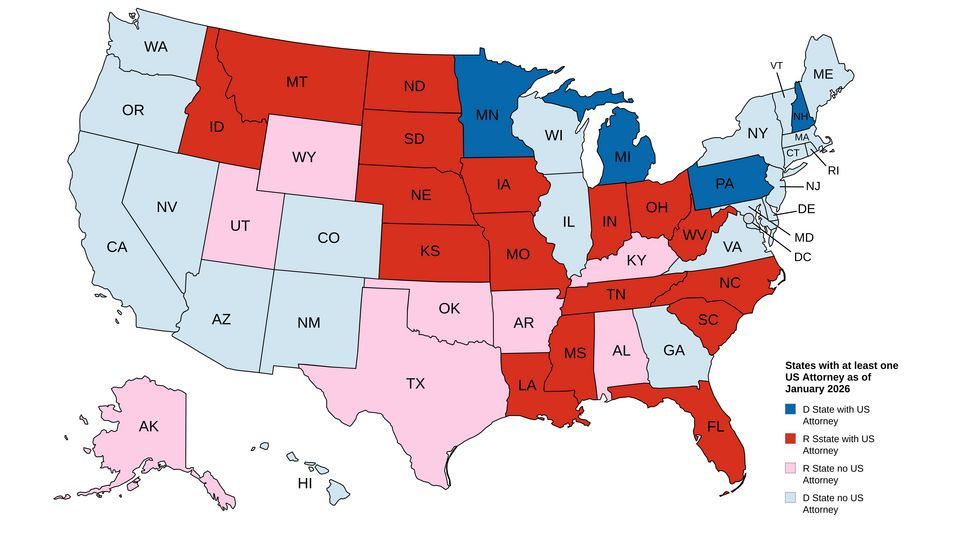
Note that there are 17 states with Republican Senators that have at least one Senate confirmed US Attorney and only 7 Republican States without a Senate confirmed US Attorney. The odds of a citizen living in a Republican state not having a valid Senate-confirmed US Attorney is only 7/24 equals 30%.
By contrast, there only 4 states with Democrat Senators with at least one US Attorney and 20 Democrat States without a Senate confirmed US Attorney! The odds of a citizen living in a Republican state not having a Senate-confirmed valid US Attorney is only 20/24 equals 83%.
Thus a person living in a state with a Democratic Senator is 4 times more likely to not have a valid US Attorney than a person living in a State with one or more Republican Senators.
The real world effect of the current unconstitutional regulations is that one full year after the beginning of the new administration, the effect of the 2024 election changing administrations has only occurred in Republican states and citizens living in States with Democratic Senators do not have a valid Senate approved US Attorney to submit their Petitions for Redress of Grievances. The seriousness of this problem is addressed in the next section.
Section 7 Historical importance of the Redress of Grievances clause and the Right to Due Process Clause
In Section 1 of this complaint, we summarized 7 complaints we filed with the US Department of Education and the US Department of Justice during the past year. These complaints provide evidence that the inalienable rights of millions of citizens are being violated here in Washington state – including violations of several clauses of the US Constitution, several federal laws and several US Supreme Court rulings.
These violations are serious crimes which require investigation – similar to filing a complaint with the local Police Department. The US Department of Justice is the federal agency in charge of enforcing federal laws. The specific person at the Justice Department who is supposed to investigate violations of federal law and file charges if they find enough evidence that a federal crime has been committed is the US District Attorney. If there is not a valid Senate confirmed US Attorney to investigate federal crimes and file charges in federal court, then our Constitutional rights become meaningless. Even rulings of the US Supreme Court become meaningless.
This is especially true in the current case where we have provided evidence in our 7 previous complaints that the political leaders here in Washington state are committing federal crimes, violating our Constitutional rights and ignoring US Supreme Court rulings.
One might claim that the US Department of Justice itself has the power to investigate our complaints and file charges in federal court. While this is technically true, as a practical matter, it is not reasonable. The United States is a very large nation of 330 million people. It is not reasonable to expect that Pam Bondi or Harmeet Dhillon can defend all of the rights of all 330 million people in all 50 states. This is why our nation has been divided into 93 federal districts with 93 US District Attorneys. Here in Washington state, we have two federal districts (Western and Eastern) to protect the rights of 8 million people. This is 4 million people per US District Attorney. Assuming each US Attorney oversees an office of about 100 prosecutors, or people who do the actual local investigations, this is only one federal prosecutor for every 40,000 people. If there is not a valid US Attorney to investigate federal crimes and enforce federal laws and federal civil rights, then those laws and civil rights become meaningless.
Why Acting or Special US Attorneys are not valid US Attorneys
There are no “temporary” or “interim” or “acting” or “special” US Attorneys in the US Constitution. Congress has the right to pass laws creating new federal officers – including inferior officers. But the process for the appointment of these new inferior officers must comply with the Appointments Clause of the US Constitution. As we explained in Section 2 of this complaint, the Appointments Clause (Article II, Section 2, Clause 2) provides only four specific ways for appointing inferior officers:
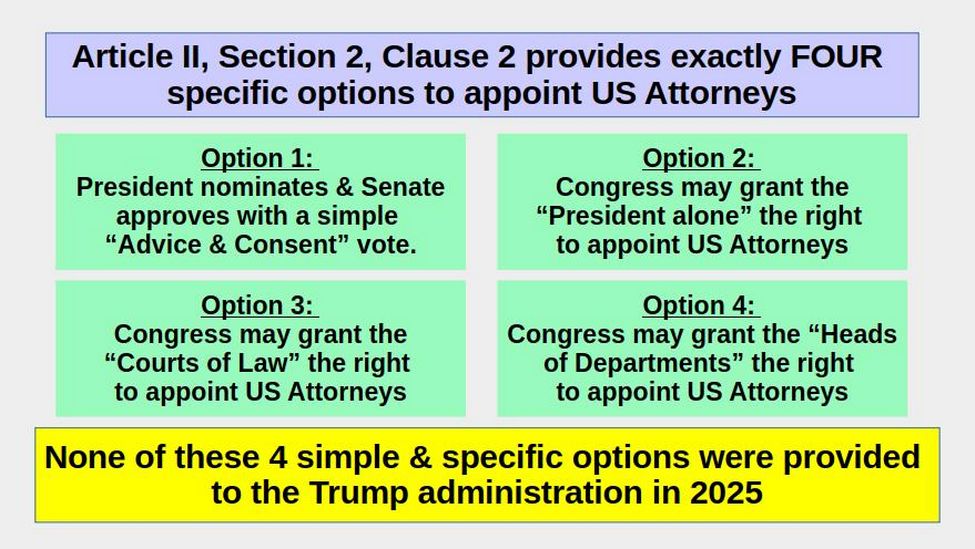
But instead of passing a law in keeping with one of these four provisions, Congress has passed several laws including Section 541, Section 546 and the NVRA which claim to create temporary or interim US Attorneys. But all three of these laws contain several limitations and obstacles to appoint these temporary US Attorneys – and these limitations are contrary to the plain meaning of the Appointments Clause. Thus, all three of these laws are unconstitutional.
The US Supreme Court has ruled that the “default” option for appointing inferior officers is Option 1 – namely appointment after the “Advice and Consent” of the Senate. Sadly, this option is not possible in Washington state due to the Blue Slip threats of Washington Senator Patty Murray.
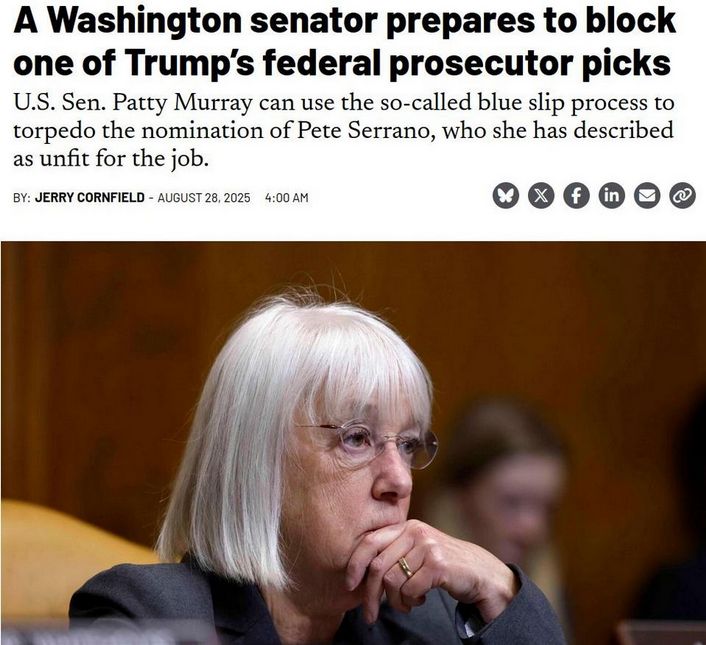
Here is a quote from the above article:
“Patty Murray, Washington’s senior Democratic senator, opposes his selection and plans to use a Senate maneuver known as the “blue slip” process to prevent the Pasco lawyer from serving in the federal post.”
“ I will be using every legislative tool I have to block his confirmation,” she said.
The century-old practice has irked President Donald Trump, who has had some of his picks opposed by Democratic senators. He has called it “old and outdated” and threatened legal action to end it:
“I have a Constitutional Right to appoint Judges and US Attorneys, but that RIGHT has been completely taken away from me in States that have just one Democrat United States Senator,” Trump posted on social media.
On August 6, 2025, Attorney General Pam Bondi appointed Pete Serrano to be the Interim US Attorney for the Eastern District of Washington state. Pete Serrano is an advocate for protecting parents rights. The interim appointment end December 9 2025.
As the US Attorney for the Eastern District of Washington State, Serrano supervises a staff of approximately 79 prosecutors, civil litigators, and support personnel, according to the Department of Justice.
On August 28, 2025 Washington Senator Patty Murray, stated that she would do everything in her power – including the Blue Slip - to prevent Serrano from being considered by the US Senate. As a result of Senator Murray’s threat, Serrano was never nominated, as being nominated and rejected would disqualify him from serving.
Pete Serrano has stayed on as the top federal prosecutor in Eastern Washington despite his temporary appointment running out after being blocked with the blue-slip process by Senator Patty Murray. This is because Attorney General Pam Bondi gave Serrano two new job titles—First Assistant United States Attorney and “special attorney”—allowing him to continue leading the Eastern District office until a new US Attorney is officially named.
Senator Murray replied to legal maneuver of the Department of Justice by stating “This move spits in the face of the law and Congress — and it sets a dangerous precedent and risks jeopardizing the legitimacy of the US Attorney’s Office moving forward.” In her statement, Senator Murray called the Bondi appointment of Serrano to be a “special” US Attorney, “a transparent end run around the Constitution and Congress”.
In Section 3 of this complaint, we provided a summary of several recent federal court cases – all of which concluded that “First Assistant” US Attorneys and “Special” US Attorneys were not “valid” US Attorneys because these offices were not in keeping with either the US Constitution or the laws passed by Congress.
All of the federal judges in all of the cases concluded that, despite being appointed by Pam Bondi, all of the “special” US Attorneys she appointed were not valid US Attorneys and therefore did not have the authority to file complaints in federal courts. Several of the judges then dismissed the complaints. For example, on November 24, 2025 a federal judge issued a 29 page opinion dismissing a criminal case against former FBI Director James Comey on the grounds that the interim US attorney who filed the charges, Lindsey Halligan, was unlawfully appointed. Here is a link to the Comey Dismissal Order.
Here is a quote from this Opinion: “Mr. Comey now moves to dismiss the indictment on the ground that Ms. Halligan, the sole prosecutor who presented the case to the grand jury, was unlawfully appointed in violation of 28 U.S.C. § 546 and the Constitution’s Appointments Clause. As explained below, I agree with Mr. Comey that the Attorney General’s attempt to install Ms. Halligan as Interim U.S. Attorney for the Eastern District of Virginia was invalid. And because Ms. Halligan had no lawful authority to present the indictment, I will grant Mr. Comey’s motion and dismiss the indictment without prejudice.”
Sadly, the Department of Justice has thus far failed to argue that the three federal laws on which the judges have been ruling the US Attorney appointments to be invalid are themselves in violation of the Appointments Clause of the US Constitution. We are therefore facing a Constitutional Crisis in which millions of citizens in states such as Washington with Democratic Senators do not currently have a valid Senate confirmed US Attorney to investigate the complaints we have submitted.
The only group with the authority under the US Constitution to resolve this dispute between the Executive Branch and the Legislative Branch is the US Supreme Court. However, the US Supreme Court has been very reluctant to challenge either the constitutionality of laws such as Section 541 passed by Congress or rules such as the Blue Slip policy passed by the Senate.
The Justice Department will have to provide the Supreme Court with reasons that go beyond merely claiming that Trump complaining that his right to appoint US Attorneys has been taken away “in States that have just one Democrat United States Senator.”
The Justice Department will have to explain how and why the Senate Blue Slip policy violates the US Constitution. But even if the Senate Blue Slip policy were ruled unconstitutional, the Senate could still block the appointment of US Attorneys. Imagine if the Democrats take over the US Senate in 2026. They could simply come up with other rules. Or hold hearings and votes in which all of the Presidents US Attorney nominations are rejected. While this has never happened in the past, what happened in 2025 also has never happened in the past. Congress could also continue to use the complex limitations of Section 541, Section 546 and the NVRA to block US Attorneys.
This is why in addition to letting the Supreme Court know that the Executive branch is being harmed by the Senate Blue Slip policy and Section 541, Section 546 and the NVRA, the First Amendment Right of the People to Petition the Government for Redress of Grievances is also being harmed. The Department of Justice and the Supreme Court should insist on a solution which restores the right of the American people to have a valid, Senate approved US Attorney in every federal district. We will therefore explain here in this section why this right exists and why it is so important to a functioning government.
The Three R’s… A Right to Petition includes the right to a Reply and a Remedy
The Right to Petition the government for redress of grievances dates all the way back to the Magna Carte and includes the Right to a Reply and a Right to an enforceable Remedy. As an initial and important clarification, I want to make it clear that by the word “petition”, I am not referring to a “political” petition (which may be directed at Congress seeking to change an existing law or create a new law). Instead, I am referring to a legal petition - which is directed at the Executive Branch (originally directed to the King) and seeks to investigate violations of existing laws and enforce existing federal laws and/or constitutional rights.
First Amendment Right to a Remedy and the Magna Carta
The words “petition” and “redress” in the Petition Clause of the First Amendment are rendered meaningless if the Clause merely includes the right to ask for redress. Instead, this clause derives directly from British Common law and the Magna Carta in which the words “petition” and “redress” include the affirmative right to a meaningful remedy - which in turn includes a mandatory duty by the Government to acknowledge, investigate, debate and most importantly vote on the issues raised by the petition. It is only by the action of voting on grievances that the citizens will be able to determine who to vote for or against in the next election.
This essential right is based on an ancient legal principle: “Ubi jus ibi remedium” which translates into English as “Where there is a right, there must be a remedy.” While the 1215 version of the Magna Carta codified due process rights in chapter 39, a right to a remedy in chapter 40 and the right to petition in Chapter 61, the 1225 version combined these chapters into a single chapter 29.
Chapter 40 of the original 1215 charter and read as follows: “To no one will we sell, to no one deny or delay right or justice.”
Chapter 61 of the 1215 charter — the right to petition — reads, in part:
“If we . . . offend in any respect against any man, or transgress any of the articles of the peace or of this security, and the offence is made known to four of the . . . twenty-five barons, they shall come to us . . . to declare it and claim immediate redress. If we . . . make no redress within forty days . . . the four barons shall refer the matter to the rest of the twenty-five barons, who may distrain upon and assail us in every way possible, with the support of the whole community of the land.”
Chapter 61 used the term “redress” four times and in each case specified what would happen if the redress was not promptly supplied. This redress had to include an actual remedy or resolution of the complaint or legal petition of grievance.
The King had an affirmative duty to respond and provide redress or remedy to legal petitions under the Magna Carta. The English verb “petition” derives from the Latin verb “peto,” a conjugated form of which is used in the very first codification of the right to petition in the 1215 Magna Carta. In that document, the Latin verb is clearly used to refer to a demand rather than a request.
The principle was further clarified in the famous case of Ashby v. White (1703) 92 Eng. Rep. 126, 137 which emphasized the reciprocity of rights and remedies: the equitable maxim that “equity will not suffer a wrong without a remedy.”
“If the plaintiff has a right, he must of necessity have a means to vindicate and maintain it, and a remedy if he is injured in the exercise or enjoyment of it; and indeed it is a vain thing to imagine a right without a remedy; for . . . want of right and want of remedy are reciprocal. . . . Where a man has but one remedy to come at his right, if he loses that he loses his right.”
A remedial right logically entails a correlative remedial duty on the part of the government, and a remedial duty logically entails remedial power. But the overriding objective of the Bill of Rights, as indicated by the very first word of the First Amendment, was to constrain — not to aggrandize — federal power
Two years after the ratification of the Bill of Rights in 1791, the Supreme Court decided Chisholm v. Georgia, a dispute between an individual seeking judicial redress for legal injury and a state invoking sovereign immunity from federal court jurisdiction. Chisholm v. Georgia, 2 U.S. 419 (1793). In a 4–1 decision, the Court came down decisively on the side of individual remedial rights, declaring that Article III gave federal courts jurisdiction to hear a lawsuit filed by a British subject against an unconsenting state
The 1803 case of Marbury v Madison also provide strong evidence that the Founding generation understood the right to petition the Government to include the right of legally injured persons to obtain meaningful remedies. Writing for a unanimous court, and citing Blackstone, Chief Justice John Marshall emphasized the individual’s right to obtain — and the courts’ corresponding duty to provide — meaningful judicial redress for a meritorious legal grievance. Marshall declared it “a settled and invariable principle, that every right, when withheld, must have a remedy, and every injury its proper redress. When it comes to individual legal rights, he “who considers himself injured, has a right to resort to the laws of his country for a remedy.
Marshall characterized “the right of every injured individual to claim the protection of the laws as the very essence of civil liberty” and affording such protection among “the first duties of government… “If the laws furnish no remedy for the violation of a vested legal right,” Marshall warned, the United State government “will certainly cease to deserve the high appellation of being emphatically termed a government of laws, and not of men.”
It is essential that the remedy not only address the current violation of our constitutional rights – but also deter future Congressional violations of our constitutional rights.
While the Supreme Court does not have the power to require Congress to adopt any particular solution, the Supreme Court can order Congress to act in a reasonable manner – consistent with Article II, Section 2 Clause 2 - to insure that the right of the People to have a valid US Attorney is maintained. Because “Justice delayed is Justice denied,” an example of what would be considered reasonable should be provided.
The Due Process clause of the Fifth Amendment also supports our claim that we, the People, have a right to a valid US Attorney
The Due Process clause of the Fifth Amendment also supports our right to have a valid Senate confirmed US Attorney in order to protect our civil rights through legal petitions submitted to US District Attorneys.
The Fifth Amendment states in part: “No person shall be… deprived of life, liberty, or property, without due process of law…”
The word liberty was used by the drafters of our US Constitution to be equated to our civil rights. Without our civil rights, there is no liberty. Without the US Attorney, we have no local person to turn to to protect our civil rights and our liberty.
In addition, the words “due process of law” in the context of protecting our civil rights is not possible without a US Attorney. This particularly true in Washington state where the Washington State Attorney General has access to hundreds of State Attorneys. No private person can possibly stand up to such a mob of State attorneys. The only person in our state who might be able to stand up to this mob of state attorneys is the US Attorney.
In the next section, we will provide a framework for permanently restoring the right of the people to have a valid US Attorney in every federal district.
Section 8 Proposed remedy to restore the right of the People to a US Attorney in each federal district
The executive branch must be allowed by the Senate to provide citizens with a US attorney in each federal district. Senate Rules, either formal or informal that go beyond “advise and consent” and instead “block and obstruct” violate both the Redress Clause of the US Constitution and the Fifth Amendment “due process” clause.
The local US attorney must accept and investigate and respond to all complaints of violations of constitutional rights and federal laws. If the claims are found to be valid, the US attorney must seek enforcement in federal courts. It is then up to the federal courts to decide if rights or laws have been violated and if so, what the legal remedy would be.
The final issue is: what a permanent solution to this constitutional violation would look like? What would be a reasonable remedy?
We think that the remedy must include at least three components:
First, we ask that the Department of Justice demand that the US Senate end this Blue Slip practice - and should the Senate refuse to end Blue Slips - that this Blue Slip policy be taken to the US Supreme Court for a ruling that prevents the US Senate from using the Blue Slip policy to abridge and obstruct the First Amendment right of the people to petition the Government for redress of grievances.
Second, we ask the Department of Justice to seek a ruling from the US Supreme Court that 28 US Code Sections 541 and 546 and the NVRA are all unconstitutional violations of Article II, Section 2, Clause 2 of the US Constitution.
Third, we ask that the time to provide the People with a US attorney in each federal district can not exceed a reasonable period of time after the election of and installment of a new government. As one example of a reasonable period of time, it is understood that the first task of a new government is appointment of Principal Officers. Assuming the new government submits the nominees for these Principal Officers within one month of taking office, the Senate must hold hearings and vote on all these principal officers within one month after receiving the nominations.
Assuming that the Senate receives the nominees for the 93 US attorneys within two months of taking office, the Senate must hold public hearings and public votes on these US Attorney Nominees within one month after receiving these nominees.
Should the Senate reject one or more nominees, Congress should choose one of the three options in Article II, Section 2, Clause 2 for selecting a US Attorney. As a reminder, these three mutually exclusive options are:
#1: The President chooses US Attorneys – no limitations.
#2 The head of the Department (aka US Attorney General) choosesUS Attorneys – no limitations.
#3 The Courts choose US Attorneys – no limitations.
To be clear – Article II, Section 2 Clause 2 only permits the selection of one of these options. If Congress should choose the the third judicial option, then the courts will have a mandatory duty to choose a US Attorney in every federal district that does not have a valid, Senate confirmed US Attorney within one month after the date that the Senate voted against confirmation of a nominee (it will not be an optional duty as is the case under the current unconstitutional federal laws). Allowing a US Attorney from the prior defeated administration to continue in office should only occur with the consent of the current newly elected administration.
This entire process should not exceed four months from the time the new administration takes office. The key point is that somebody must choose a US Attorney and that the People can not have their right to a US Attorney delayed by either the Congressional Branch, the Legislative Branch or the Judicial Branch for more than four months.
The other key point is that we are only seeking this ruling for the 93 US Attorneys. While it has been estimated that there are more than 1000 “inferior officers”, we contend that the US Attorneys serve a “core and essential” function of the Executive branch and that this core function is essential to protect the civil rights of the people.
Limitation of Supreme Court ruling to US Attorneys
We also recognize that each administration is limited to a term of four years and thus, there is a need to have US Attorneys appointed during the first year of each administration in order for the new US Attorneys to have the time needed to investigate Civil Rights complaints and file charges in federal courts before the end of the first year of the new administration – in order to give the federal District Court, Court of Appeals and US Supreme Court a chance to rule on the issues raised in citizen complaints and the charges filed by the US Attorneys.
We understand that the Blue Slip process is also being used to block judicial appointments. But because judicial appointments are not time limited (federal judges have lifetime appointments), a different process may be appropriate to protect the right of the people to federal judges.
Conclusion
It is apparent from reading the Federalist Papers that neither Madison or Hamilton ever imagined a day in which a few Senators from the party that lost the election would be able to use an unwritten Senate Blue Slip rule to block the appointment of US Attorneys in 90% of the States with a Senator from the losing political party. But that is exactly what happened in 2025.
The People living in those states have had both their First Amendment Right to Petition and their Firth Amendment Right to Due Process severely abridged by this shocking and unconstitutional action.
We, the People living in one of these States, ask the Justice Department to seek a ruling from the US Supreme Court to enforce Article II, Section 2, Clause 2 of the US Constitution in order to restore our civil rights as well as our right to have a valid US Attorney.
Finally, once we have a valid US Attorney in either the Eastern or Western District, we ask that our seven prior civil rights complaints be investigated, and if found to be valid, that the US Attorney seek a remedy in federal court as soon as possible.
Feel free to contact me if you have any questions or need additional information. Thank you for helping us restore our civil and parental rights.
Sincerely,
David Spring M. Ed.
Director, Washington Parents Network