
As our kids head back to school here in Washington, they will sadly be subjected to yet another year of Trans Drug Cult propaganda. This is despite US Supreme Court rulings that schools can not keep parents in the dark about the kinds of Trans Cult lies and brain washing teachers are telling our kids. This is therefore a good time to review the latest scientific evidence on the many severe harms inflicted on our kids by Trans Drug Cult spreaders that are still dominating schools here in our state.
Let’s begin with a provably false statement recently made by our State Superintendent (and sadly repeated by many teachers during the first few weeks of school): “It is quite simply INACCURATE to say BIOLOGICALLY that there are only boys or girls. There is a “CONTINUUM.”

To support his claim, Reykdal refers to children who have one of several genetic problems commonly lumped together and called “intersex”. As I explained months ago in this article, depending on which genetic problems are included, less than one in one thousand kids might be classified as Intersex. A 2021 genetic study of 1,376 people who fell victim to the Trans Drug Cult found that 99% did not have any genetic problem. Thus for at least 99% of all Trans victims, their problem in rejecting their actual sex is a mental health problem and not a genetic one.
Equally important, the solution for kids with mental health problems is mental health counseling – not getting these kids addicted to toxic Trans Drugs. But giving gender confused kids scientifically accurate mental health counseling has for several years been banned here in Washington – despite a Supreme Court ruling that this ban on mental health counseling violates our rights under the US Constitution.
The primary claim used by leaders of the Trans Drug Cult to justify ignoring federal laws and Supreme Court rulings and violating the right of parents to make important health decisions for their children is the false claim that giving kids toxic Trans Drugs will reduce their suicide rate. There has never been a single credible scientific study to support this claim. But there have been many studies that found just the opposite – that encouraging kids down the Trans Drug Cult Trap increases their risk of suicide.
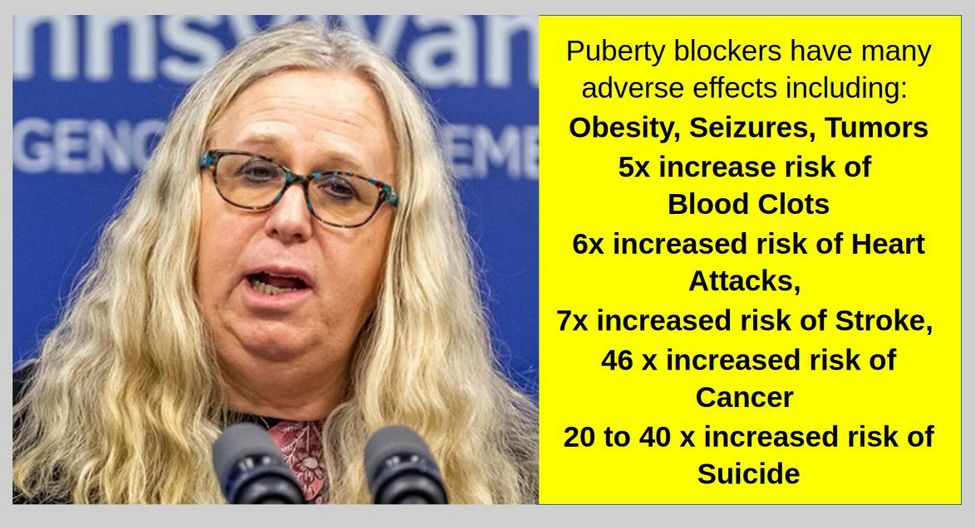
These studies were done in several Western nations including the Netherlands, Sweden, the United Kingdom, Denmark, Finland and the US. Each studied gender confused people over a long period of time. Each study included a large number of people. The number of participants in these studies ranged between 324 to 107,000, with an average of more than 6,000 participants. The duration of each study was from 5 and 46 years with the average study running over 31 years.
The studies included a follow-up - either reconnecting with trans participants or re-examining data after individuals had progressed through the Trans drug and mutilation pathway. Participants ranged in age from as young as 11 at the time they started taking Trans Drugs and joined the studies, to those in their late twenties and early thirties. All of them found that the Trans pathway worsened the mental health problems of their victims and increased the risk of suicide.
Here is a brief description of some of them:
The Wiepjes 2020 study of 8,163 trans persons over 45 years followed up contact every five years with its original participants. It found that over the period of the study there had been eight transgendered men complete suicide and 41 transgendered women. The suicide rate was substantially higher than the suicide rate in the Dutch population.
The de Blok 2021 study of 4,568 trans persons over 46 years found that the victims, post receiving Trans drugs and/or surgery demonstrated significantly higher rates of mortality by heart disease, lung cancer, HIV related death and by completed suicide compared to expected mortality rates in the general Dutch population.
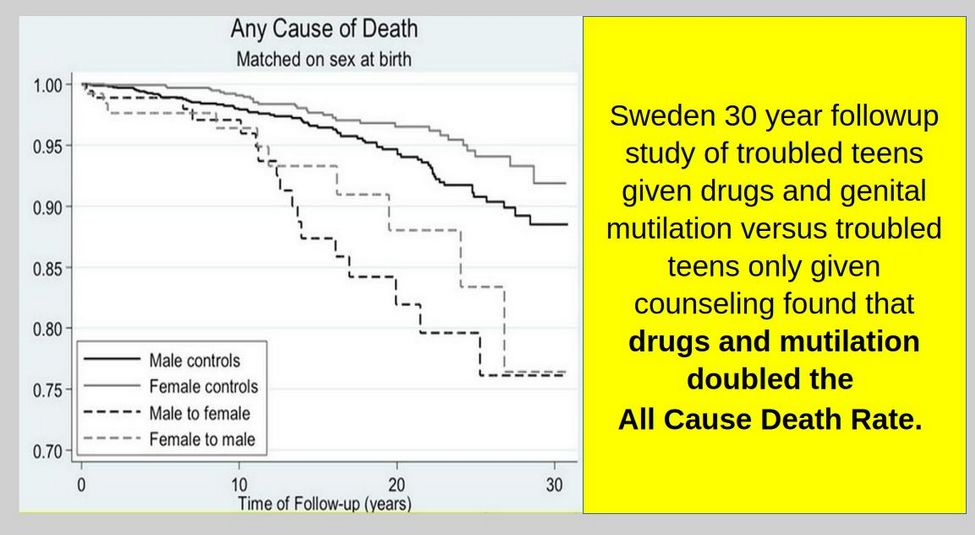
The Dhejne 2011 study of 324 trans persons over 30 years found that rates of attempted and completed suicides were significantly higher for these trans clients who received transgendered healthcare than expected rates for non transgender peers.
The most at-risk stage for these trans victims was post Trans surgeries where the completed suicide rate was 19 times higher than non-trans peers. This is significant since nearly all young kids who get hooked on Trans Drugs eventually opt for surgery before they realize that drugs and surgery do not address their mental health problems.
The Erlangsen 2023 study of 3,759 Trans victims over 41 years found there was 92 post treatment suicide attempts and 12 completed suicides. These rates for suicide attempts and completed suicide were ‘significantly higher’ compared to the general population.
The Appleby 2024 study of 15,032 trans youth from the Tavistock Clinic in London over five years found there were 12 completed suicides during this time. Half of these victims were over 18 and half of the completed suicides were under 18. These completed suicide rates were similar to the rate for age similar peers who had a mental health diagnosis but did not identify as trans- further evidence that trans suicide rates are related to mental health problems. Completed suicide rates were much higher for trans victims than for age similar non trans youth. The study also found there was no increase in the rate of completed suicide or statistical change for trans youth in completed suicide post 2020 when there was less access to puberty blockers and cross sex hormones begun, despite predictions of a ‘suicide surge’ at this time.
The Ruuska 2024 study of 2,083 trans victims over 23 years indicated that the average age of those entering their study was 18.5 years. This was the only study with a control group of young adults of similar age, stage and from similar location. There were 16,643 in this control group. The study found there were 55 deaths in the study group over this 23-year span. Of those deaths, 20 were by completed suicide (36%). This indicated that compared to the control group, general mortality was 66% higher and death by suicide was 300% higher.
The most recent 2025 US study by Lewis et al., (Examining gender-specific mental health risks after gender-affirming surgery: A national database study) was one of the largest to examine mental health outcomes of Trans Cult victims using real-world healthcare data.
The study analyzed data from more than 107,000 people diagnosed with gender confusion between 2014 and 2024. Equally important, the researchers examined objective mental health outcomes based on actual clinical diagnoses recorded in medical records.
Their findings revealed that among individuals recorded as male in the medical records who were diagnosed with gender dysphoria, those who underwent surgery experienced more than double the rate of depression compared with those who did not (25.4% vs. 11.5%), and nearly five times the rate of anxiety (12.8% vs. 2.6%). Suicidal ideation and substance use disorders were also more common among the surgical group. A similar pattern appeared among patients recorded as female. Those who underwent surgery were more likely to receive diagnoses of depression (22.9% vs. 14.6%), anxiety (10.5% vs. 7.1%), suicidal ideation (19.8% vs. 8.4%), and substance use disorders (19.3% vs. 7.1%) compared with those people who did not go ahead with surgery. These findings are significant because giving young kids toxic Trans Drugs is strongly related to undergoing surgery in later years.
This study seriously undermines the primary justification for expensive and irreversible Trans surgery - that these surgeries improve people’s mental health – showing that this claim is not supported by population-level evidence. It also adds to other population-based findings, including Bränström and Pachankis (2020) and Ruuska et al. (2024) which reported higher rates of psychiatric treatment (including antidepressant and anxiolytic prescriptions, as well as hospitalisation following suicide attempts) among transgender individuals who underwent Trans Surgery than among those who did not. Trans surgery is associated with poorer mental health outcomes rather than improvements.
It should be obvious that kids with mental health problems would be better off getting mental health counseling instead of getting addicted to drugs that will actually make their mental health problems worse. But we are living in a state where political leaders do not care about scientific studies or genetic facts.
The good news is that nationally, the Trans Drug Cult is finally being exposed as the Money Making Scam that it is. On August 13, 2026, the U.S. Department of Health and Human Services released a report “Wolves in White Coats: How Doctors and Hospitals Pushed and Profited from the Fraud of “Gender Medicine.” This 64 page report examined fraudulent insurance coding practices, perverse financial incentives, and the provision of sex-rejecting procedures for minors. A 12 minute video illustrating the report’s findings and highlighting the stories of victims of predatory gender medical practices was also released in conjunction with the report.
Here are a few quotes from this report:
“In the early 2020s, healthcare providers began subjecting children to experimental sex-rejecting procedures in rapidly increasing numbers, despite a paucity of adequate evidence for long-term safety and efficacy for these interventions. Such a large-scale medical shift requires the blessing of large institutional actors like hospitals. This report exposes, for the first time, the involvement of hospitals in promoting life-altering drugs and surgeries for children who express discomfort with their sex.”
“How was this madness allowed to fester under America’s hospital system? This report concludes that a litany of political and financial incentives led providers to offer, and indeed urge, the prescription of sex-rejection drugs and surgeries for minors.”
“First, healthcare providers were able to turn a tidy profit from these procedures: children who “transitioned” were placed on a course that would require expensive drugs, surgeries, and lifelong medical interventions. While not limited to these providers or institutions, we will cite examples of clinics from multiple states situated within major academic medical centers, large private hospital systems, and community-based clinics. These institutions and providers participate in federal programs including Medicaid and Medicare that treat children, adolescents, and adults. Doctors and entities that provide these services could profit immensely.”
“And this report highlights evidence that healthcare providers may have secured insurance coverage for these procedures, increasing their bottom lines, through potentially fraudulent means. In particular, there is reason to believe that some (perhaps many) providers of sex-rejecting procedures systemically diagnose minors with physical conditions they did not have in order to secure insurance coverage for “treatments” (like breast removal or hormones) that insurers (including Medicaid and Medicare) might not otherwise have covered had they been provided with accurate information. If true, the entities that took these steps face potentially serious criminal and civil liability.”
“In the 2010s, financial incentives contributed to the rapid expansion of Trans gender clinics and programs by creating long-term revenue opportunities for these medical establishments… Unlike traditional pediatric services, which involve short‑term care, children receiving puberty blockers, cross-sex hormones, surgeries, and related services may require recurring endocrinology visits, laboratory monitoring, prescriptions, surgical procedures, and follow‑up care extending into adulthood. This pediatric medical field effectively creates “captive patients.”
“This “captive patient” dynamic stands in stark contrast to patterns typical of routine pediatric care, which tends to focus on acute or self-limited conditions according to data from the National Center for Health Statistics. For example, a single pediatric clinic visit might be to treat an ear infection, or a one-time hospitalization to treat a rotavirus infection. One outpatient study examining data between 2008 and 2013 found 82% of pediatric patients had no chronic conditions; those with multiple chronic conditions had more visits but represented a minority of patients seen in this setting.”
“In contrast to typical one-time visits for acute conditions or well-child checkups, a child presenting with gender dysphoria enters a pipeline of regular endocrinology visits, laboratory monitoring for hormone levels and side effects (bone density, liver function, lipid profiles, fertility counseling), mental-health follow-ups, and potential escalation to irreversible surgical procedures. For example, the Endocrine Society’s Clinical Practice Guideline (2017) recommends for those on puberty blockers or cross sex hormones a clinical assessment every 3-6 months, laboratory draws every 6-12 months, and bone density scans every 1-2 years into adulthood.”
“Each step generates billable encounters, prescriptions, and facility fees. Once initiated—often with puberty blockers or cross- sex hormones in early adolescence—the patient requires ongoing care for decades. Insurance re- imbursements, whether private or public, create a predictable, high-margin stream for pediatric endocrinology, adolescent medicine, plastic surgery, urology, and gynecology departments.”
“Cost data estimates illustrate the scale of these revenues. According to a comprehensive 2022 analysis of commercially insured transgender patients using claims data spanning nearly three decades, cross-sex hormone therapy entails average yearly payer costs per patient ranging between $545 (androgens), $735 (estrogens), and $16,385 (for the more costly puberty-blocker GnRH). Lifetime totals for a patient starting as a minor can reach $25,000-$75,000 even without surgeries.”
“For context, we can compare this to average healthcare spending for children under the age of 18, which is typically around $3,000. While modest on a per-year basis, these expenses recur annually for the patient’s entire adult life, creating compounding revenue for health systems.”
“Surgical interventions dramatically amplify the financial upside. “Top surgery” (mastectomy with chest masculinization for females) carries a per-procedure mean health-plan-paid cost of $12,680, with additional out of pocket costs of $2,244. Similarly, mammoplasty costs insurers $17,426 per patient with an additional $1,223 out of pocket. “Bottom surgeries”—vaginoplasty for males and phalloplasty for females—are more complex and often staged over multiple episodes. Average total costs per person reach $53,645 for vaginoplasty and $133,911 for phalloplasty. These represent mean health-plan-paid amounts, excluding out-of-pocket costs, which added roughly $2,624 for vaginoplasty and $3,982 for phalloplasty on average. In addition, these procedures may require revisions for complications (urethral strictures, fistulas, loss of sensation, or cosmetic adjustments), each generating additional operating-room time, hospital stays, and follow-up care. These one-time or multi-staged interventions deliver high-margin procedural revenue to surgical specialties that otherwise might see fewer elective cases in pediatric settings.
“The lifetime economic footprint for a single patient beginning these interventions as a minor is substantial even without surgery. According to the Human Rights Campaign, estimates place total costs between $25,000 and $75,000 over a lifetime. When surgeries are included, individual lifetime spending on surgical interventions can easily exceed $100,000 and approach $170,000. These figures do not account for indirect costs such as fertility preservation (egg or sperm banking), voice therapy, hair removal, or later interventions for regret or complications—services that further embed the patient in the medical system. This dependency model mirrors chronic-disease management programs (e.g., diabetes, HIV, or oncology), but unlike treatment for those diseases, sex-rejecting procedures start with physically healthy minors who would otherwise have generated negligible lifetime revenue.”
“All‑payer claims indicate nearly $120 million in billed charges for sex‑rejecting procedures involving minors since 2019. These charges include more than 5,500 surgeries and 8,500 courses of hormones or puberty blockers. The analysis concludes that these continuing interventions have created financially valuable patient populations for hospitals and associated specialties. Cross-sex hormone therapy entails average yearly payer costs per patient ranging between $545 (androgens), $735 (estrogens), and $16,385 (for the more costly puberty-blocker GnRH). Surgical interventions, such as mastectomies, mammoplasties, and phalloplasties, can range from $12,000 to over $130,000.”
“Hospitals Misuse Diagnostic and Procedural Codes to Ensure Payment for Pediatric Sex-Rejecting Interventions. If the treatment (CPT code) is medically necessary for the diagnosis (reflected by the ICD code), then the insurer will more likely reimburse the provider for the service.22 Similarly, if the treatment is not medically necessary for the diagnosis, the insurer is less likely to provide coverage.”
“Potentially Fraudulent Medical Coding… An analysis of the data suggests that some providers may have used diagnosis codes that did not accurately reflect patients' underlying conditions in order to obtain insurance coverage for sex-rejecting procedures, particularly with ICD-10 code E34.9 (“endocrine disorder, unspecified”) and the ICD-10 codes for central “precocious puberty.”
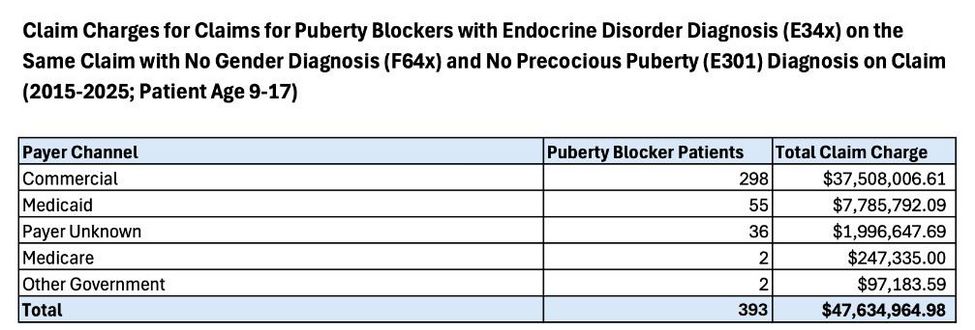
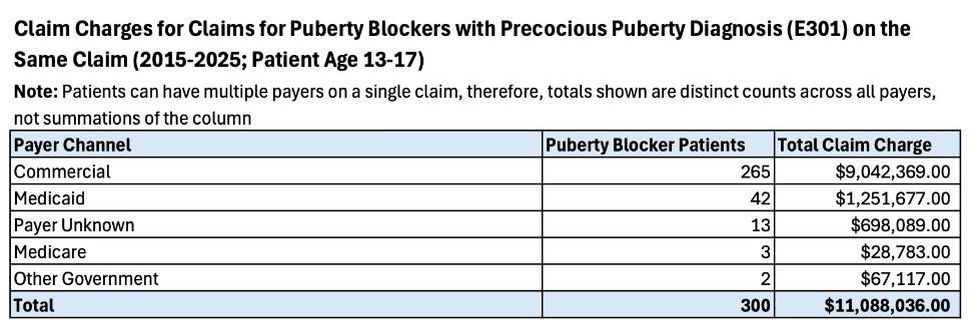
“Medical Coding for Gender Dysphoria… A provider who submits any CPT code on an insurance claim for the management of a patient with gender dysphoria should use the gender-related diagnosis codes, which include the F64 or Z87 family of diagnosis codes. Between 2015 – 2025, public and private insurance was billed nearly $50 million for puberty blocking drugs in patients aged 9-17 with Endocrine Disorder diagnoses (excluding precocious puberty, the typical indication for puberty blockers). During this same timeframe, nearly $11 million was billed for puberty blockers, including to Medicaid and Medicare, for hundreds of patients between the age of 13 and 17 with a diagnostic code for precious puberty. By definition, anyone 13 or older cannot have a diagnosis of precocious puberty and should not be given puberty blockers at that age for this indication
“Because “the ICD-10 code E34.9 (endocrine disorder, unspecified)…was sometimes used instead of ICD-10 codes related to gender dysphoria.” The authors never explain why this occurs, only that it occurs “sometimes.”
“But in fact, the study’s numbers show this code is used (misused, really) with great frequency: the report’s numbers suggest that, of the 1,480 patients who were diagnosed with endocrine disorder, unspecified, only 71 patients (4.7%) had an actual endocrine condition.”
“A Manhattan Institute analysis of all-payer claims data, which documented a 30% rise in E34.9 diagnoses among minors from 2020–2022. Sapir concludes that this trend is not likely due to a genuine increase in endocrine disorders. Rather, it reflects a “greater willingness of gender clinicians to use endocrine disorder (E34.9) codes instead of gender identity disorder (F64) codes.”46 He goes on to comment on the deliberate nature of the practice. “
“In short, the decision by leaders in the field of gender medicine to use “endocrine disorder” codes for patients who lack such disorders was deliberate and is well documented. Indeed, the openness, even pride, with which they discuss this practice shows their confidence that neither the medical establishment nor the insurance industry would dare challenge the field on this critical matter.”
“To verify the hypothesis that such miscoding is occurring, we conducted our own analysis from a nationwide health insurance claims database for the years 2015-2025. We found that public and private insurance was billed nearly $50 million for puberty blocking drugs in patients aged 9-17 with Endocrine Disorder diagnoses.”
and
“Second, medical institutions have been captured by ideology. This report contains first-hand accounts from children, and from the parents of children, pressured to undergo sex-rejecting procedures. These stories, and the data showing the explosion in sex-rejecting interventions, suggest that children suffering from gender dysphoria are likely to encounter an ideologue at gender clinics predisposed to embrace the child’s story. This, combined with the financial incentive to provide sex-rejecting procedures, creates a dangerous mix: ideologically driven doctors encourage sex-rejecting procedures, while the financial incentives give hospitals and gender clinics a reason to offer such interventions and to excuse or overlook inaccurate diagnoses.”
“Eight first-hand testimonies from patients and parents illustrate weakness in clinical safeguards and informed-consent processes. Common themes include distress related to a child’s sex and rapid medical interventions, insufficient examination of underlying psychological, developmental, social, or trauma-related factors, limited discussion of irreversible damage, pressure placed on parents to approve “treatment,” adverse physical and psychological outcomes, and difficulty obtaining appropriate medical care after stopping treatment or detransitioning.”
“These testimonies underscore the imbalance between the structured healthcare pathways available for initiating medical transition and the comparatively limited clinical infrastructure available to patients seeking to discontinue treatment, address complications, or detransition.”
“On May 15, 2026, Texas Attorney General Ken Paxton and the U.S. Department of Justice announced that Texas Children’s Hospital would pay a $10 million dollar fine—the second largest healthcare fraud settlement in the history of pediatric medicine—“for billing Texas Medicaid for unallowable and illegal ‘gender-transition’ interventions, including by using false diagnosis codes.” As part of the settlement, Texas Children’s agreed to terminate the employment of five doctors who performed these harmful medical interventions and amend its bylaws to trigger automatic relinquishment of privileges for any physician who violates Texas’s prohibition on sex rejecting procedures. The settlement also included the formation of the country’s first Detransition Clinic, and for the first five years “all services provided through the Detransition Clinic will be funded by Texas Children’s and be free of charge to patients.”
“Less than a month later on June 5, 2026, the Department of Justice announced that the Cleveland Clinic Foundation likewise reached a monetary settlement to resolve allegations regarding false billings submitted to public and private payers to secure insurance coverage for sex-rejecting procedures on minors. As part of the resolution, Cleveland Clinic also committed $2 million to provide restorative care for detransitioners regardless of their insured status or ability to pay.”
“The federal government actively pushed acceptance of sex-rejecting procedures for minors. The expansion of sex-rejecting procedures resulted from an interaction among financial incentives, potentially illegal billing practices, ideological influences, federal policy, and inadequate oversight. The medical establishment and the government failed innocent children. This report exposes how these calculated financial and political efforts left children irreversibly harmed and abandoned at the very moments when they needed real support. Drawing on Centers for Medicare & Medicaid Services Guidance, Department of Justice (DOJ) investigations, peer-reviewed scientific literature, hospital records, whistleblower testimony, nationwide insurance claims analyses, and interviews with patients and parents, the report presents HHS’ findings and recommendations about the industry pushing and profiting off so-called “gender medicine.”
“In October 2022, a federal court declared the gender identity-related portions of the guidance unlawful and vacated those provisions. Undeterred by the vacatur of the sub-regulatory guidance, HHS issued a final rule adopting the same theory in May 2024. A federal court would vacate the final rule’s gender identity-related provisions.”
“Although the Food and Drug Administration has never approved puberty blockers or cross-sex hormones as safe or effective for sex-rejecting purposes, HHS’s Office of Population Affairs issued a guidance document in March 2022 titled “Gender Affirming Care and Young People” that endorsed puberty blockers, cross-sex hormones, and “top” and “bottom” sex-rejecting surgeries starting in early adolescence.”
“National Institutes of Health, or “NIH,” has spent millions of taxpayer dollars on research related to sex-rejecting procedures. For example, NIH paid nearly $10 million for one study on puberty blockers and cross-sex hormones for youth. Study data that was unfavorable towards the use of puberty blockers was intentionally suppressed by a researcher out of concern that the findings would support state laws prohibiting sex-rejecting procedures for minors. Study data related to the use of sex-rejecting hormones was published, with the lead author misleadingly declaring that the results “provide a strong scientific basis that gender-affirming care is crucial for the psychological well-being of our patients.” The study’s hypothesis was retroactively changed after inconsistent findings; the study failed to report findings for six of the eight variables.”
“In their original (“preregistered”) hypothesis; the study contained many confounding variables, such as participant use of psychotherapy; and most significantly, two of the 315 study participants died by suicide after starting cross-sex hormones.”
First-Hand Accounts from Patients and Parents: “When a child is in distress, parents will go to any length to find help. These parents count on America’s pediatric hospitals, medical associations, and federal agencies to value science over ideology and people over profit when recommending medical procedures. Instead, parents encountered wolves in white lab coats who pushed vulnerable children down a path towards irreversible harm from sex-rejecting procedures.”
“Financial incentives from the medical industry and lobby; political and ideological pressures; and failure of oversight at the local, state, and federal levels have all contributed to the rapid medicalization of these procedures and resulted in long-term physical and psychological consequences for many patients.”
“The research and first-hand stories in this report demonstrates potential large-scale fraud, and a critical need for more accountability and oversight of medical providers, insurers, advocacy organizations, and government agencies that not only allowed, but often encouraged it. Because of the dangerous combination of ideology and financial incentives, we believe the potential fraud exposed in this report is only the tip of the iceberg.”
Science and Common Sense demand an end to the Trans Drug Cult and the protection of children and the restoration of the essential Parent- Child relationship. If you want to help restore Parents Rights in Washington State, please share this article with your friends and neighbors. Also, please take the time to attend our next monthly meeting of our Washington Parents Network – on Sunday, September 6, 2026 from 4 to 5 pm. We will review these important studies and our plan to eventually restore Parents Rights here in Washington State. If you are interested in attending this meeting (and are not already on our meeting list), send me an email and I will email you a link to the meeting. We look forward to meeting you!
Regards,
David Spring M. Ed.
David (at) WashingtonParentsNetwork.com